"Why did traffic drop?"
Was it a Google update, an AI summary or a broken template? Without independent checks you're guessing, and you'll probably fix the wrong thing.
See which URLs actually earn clicks and when AI assistants pick a competitor's roundup over yours. You'll also catch the template-level SEO issue that has been capping commissions without anyone noticing.


Sample workspace for illustration
A few URLs pay the bills. When one of them drops, gets bypassed by an AI answer or loses a merchant link, you need to know why before the month closes.
Was it a Google update, an AI summary or a broken template? Without independent checks you're guessing, and you'll probably fix the wrong thing.
A competitor clones your roundup, and theirs is the one assistants cite. If you only watch the SERPs, you won't notice for weeks.
Merchants move landing pages without telling you, and your outbound links end up in redirect chains or 404s. Audits of your own HTML catch it.
Illustrations use sample data.
Connect each property, import Search Console and map queries to the posts that actually make money. Then you refresh the right pages instead of guessing across the whole site.
See which listicles and reviews still earn impressions on buyer terms, and which get impressions but few clicks. That second group is usually where a refresh pays back fastest.
See when models cite your roundup, the merchant's own site or a rival affiliate. It matters because an answer that satisfies the shopper is a click the SERP never sends you.
Scan repeated layouts for speed, schema and broken assets. Fix the shared template once and every URL built on it gets the fix. Check mobile too, since affiliate traffic skews heavily to phones.
Get notified when rankings or AI mentions slip on the URLs tied to your top programs, so you can react before a slow month turns into a bad quarter.
The same data answers different questions depending on the season and the size of your portfolio.
Refresh the winners before peak shopping season, and leave the long tail alone unless the data says otherwise.
Point your informational posts at the commercial URLs on purpose, using internal-link data instead of linking at random.
Copy the monitoring setup that already works each time you launch a new niche or regional brand, so the new site starts life with checks in place.
Independent audits catch outbound links that rot or chain through redirects when a merchant changes its site.
Tag the posts or categories that drive most of your commissions, so everything else is measured against them.
Hook up Search Console, run an audit and turn on AI tracking for the buyer prompts that matter.
Update only the pages where the data shows upside, then re-run the audit to verify the change landed.
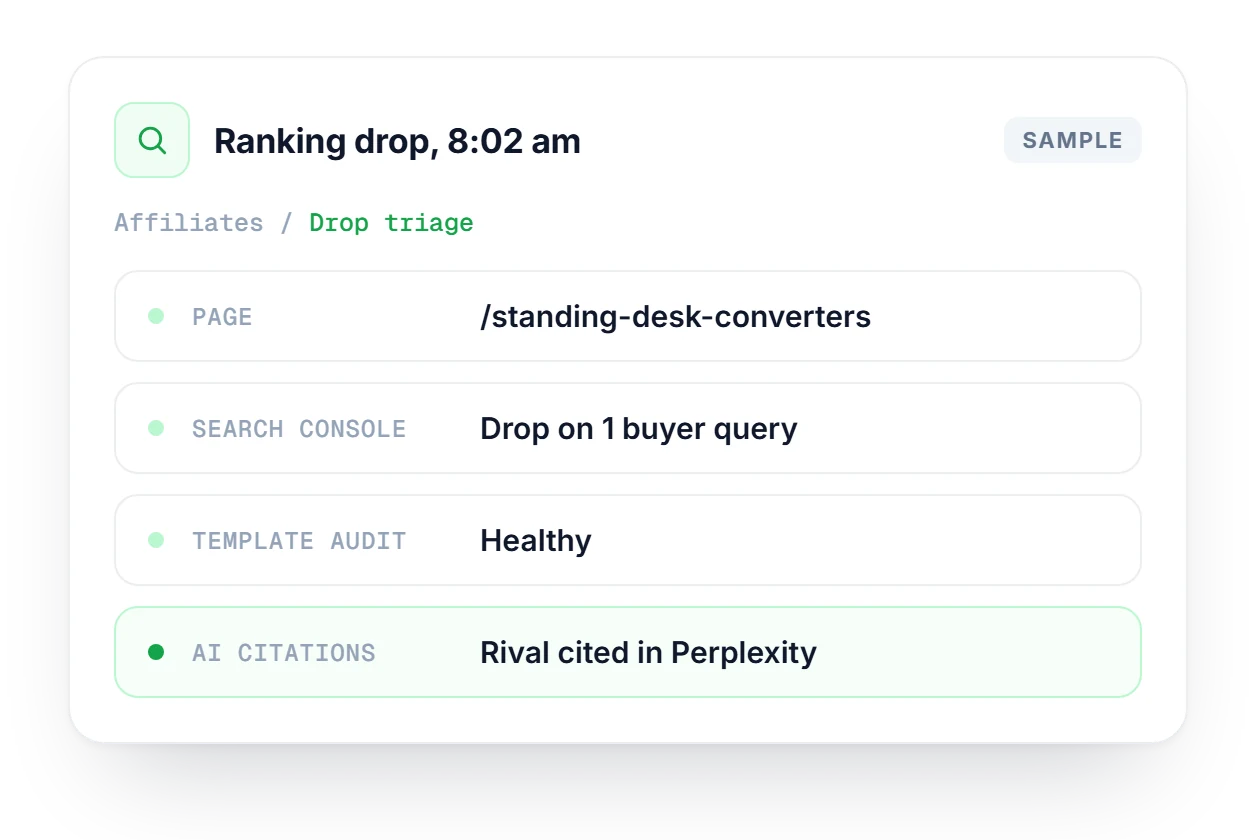
At 8am an alert says /standing-desk-converters fell from position 3 to 7. Search Console shows the drop sits on one buyer query, and a re-audit finds the template healthy. Perplexity cites a rival's converter roundup instead of yours, so you run a TrueTrace comparison, refresh that one page and re-audit it.
What Linkstonic does for money pages, and what stays on your side of the desk.
Pick the plan that matches the size of your portfolio.
Compare plans →No. It works for any program where your pages send clicks through trackable links, including Amazon, SaaS, finance and travel. Linkstonic watches your own site (rankings, AI citations and template health), so the program behind the link doesn't matter.
Yes, up to your plan's limit. Each property gets its own dashboards, so a problem on one niche site doesn't get mixed into another site's numbers. When you launch a new site, give it the same checks as the others.
No. Linkstonic shows internal linking opportunities and which competitors AI cites instead of you. Outreach and link building stay with you, or with whoever you hire to do it.
Most technical audits finish quickly. Very large crawls can sit in a queue during peak load, so if you're auditing a big site right before a seasonal push, start it a little earlier than you think you need to.
Not directly. Audits flag technical and structural issues such as missing schema, slow templates and broken links. Whether a review is too thin to deserve its ranking is an editorial call, and that one stays with you.
Self-serve plans include flexible cancellation where the Pricing page says so. Check the terms for your plan there before you sign up, especially if you like to scale up and down with the shopping seasons.
Track rankings, AI answers and template health for every money page. Pick a plan that matches your portfolio size.
Our customers
Linkstonic for our team has been a game-changer. It’s helped us work more efficiently, cutting down on manual checks so we can focus on what really matters—measuring AI visibility, fixing technical SEO, and driving growth.
+373%
Increase in
share of voice
 Discord