Discovery comes first
At scan time, five AI crawlers are checked against your robots.txt, and your llms.txt is checked too. If a crawler is blocked, start there.
Citation Gap combines your own tracking data with a live robots.txt check to find the keywords where AI engines cite competitors instead of you. Each gap comes with a reason, a severity score and a recommended fix.
Sample gap analysis for illustration
Gaps come from your own tracking on the four major engines
 ChatGPT
 Claude
 Gemini
 Perplexity
Every gap is built from your own tracked mention rates and a live check of your site. No invented metrics. You see the cause before you pick a fix.
At scan time, five AI crawlers are checked against your robots.txt, and your llms.txt is checked too. If a crawler is blocked, start there.
Each gap is coded Discovery, Authority, Content or Coverage. The code tells you who owns the fix: a developer, a writer or your PR team.
Gaps are sorted Critical, High, Medium and Low, and each fix is tagged Quick, Medium or Project effort. Start at the top.
Each gap card has one reason code and the fixes that go with it, tagged by effort so you can plan the sprint.
AI crawlers are blocked, so engines can't read the page, never mind cite it. These are usually the fastest gaps to close.
Update the robots.txt rules that disallow them
Make sure the other AI crawlers are allowed too
Point AI engines to the pages that matter most
Help crawlers find new and updated pages
Engines can read your page but trust a competitor's more. You need stronger signals that you're a source worth citing.
Show who wrote the page and why they know the topic
Back claims with links to reputable references
Same name, category and facts wherever you appear
Get referenced where engines already look
Your pages answer the query less fully, or less directly, than the pages that get cited. Better coverage of the topic closes it.
Put a clear answer near the top of the page
Add the sub-topics buyers ask about next
Short, quotable answers engines can reuse
When no page on your site targets the topic at all
Some engines mention you and others don't. It's measured as platforms tested against the platforms that mentioned you.
Compare mentions by platform for the keyword
See per-engine scores and where they diverge
Work on the factors the lagging engine scores low
Confirm the gap closes on the next lookback
Three inputs from your tracking data set how serious each gap is. 75 or above is Critical, 55 or above is High.
AI mention rate of 50% or lower, or a blocked crawler with a mention rate under 100%.
Keywords where your AI mention rate is already strong are listed too, so you know what not to touch.
The summary tiles carry a confidence note based on how your citation feedback has been calibrated.
Citation Gap runs on tracked keyword data. Add a brand and run a few tracking sessions so there are real mention rates to work with.
Open Citation Gap and choose your brand and a 30, 90 or 180 day window. Look at the summary tiles and the crawler panel first.
If crawlers are blocked, sort out robots.txt and llms.txt first. Then go through the Critical and High gap cards with the recommended fixes.
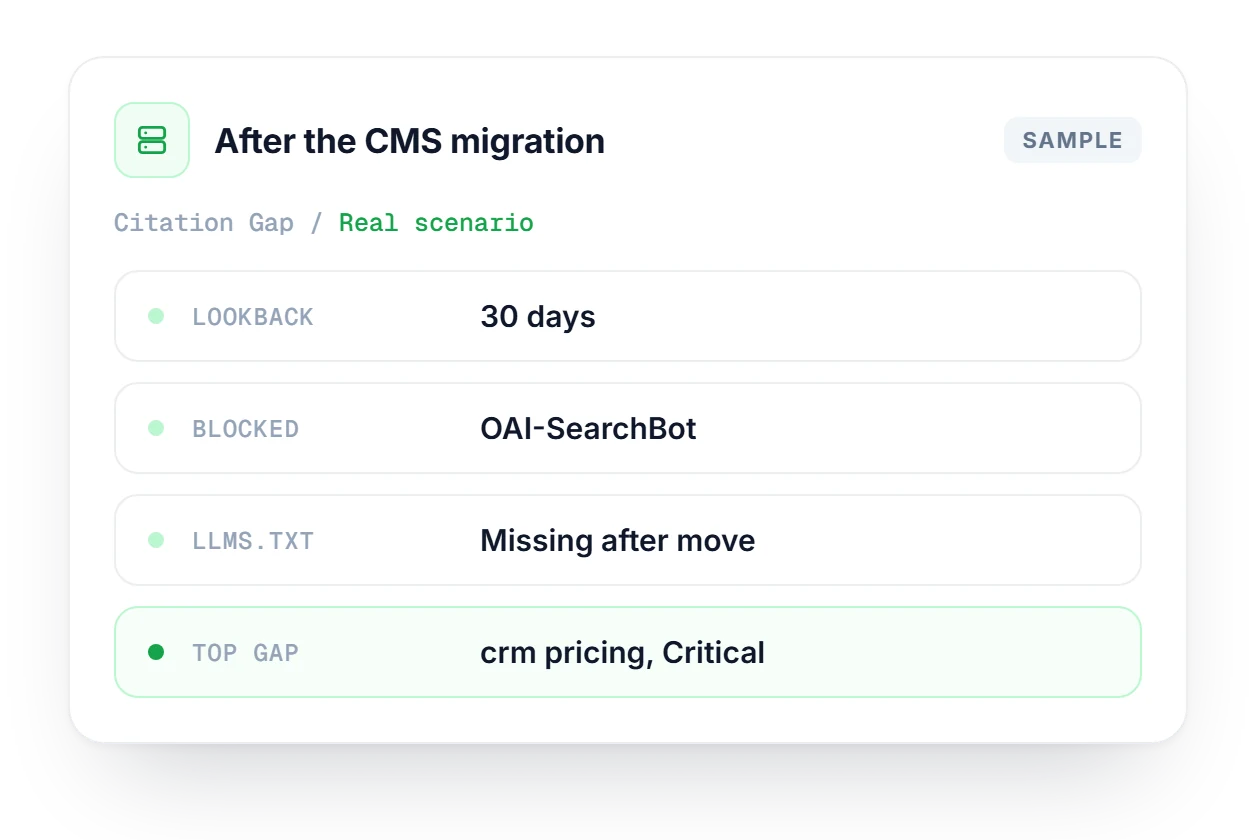
After a move to a new CMS, AI mention rates start to slide. Open Citation Gap on a 30-day lookback and check the crawler panel first: the new robots.txt blocks OAI-SearchBot and llms.txt didn't survive the move. Hand that Discovery gap to whoever owns robots.txt, work the other Critical cards like crm pricing, and refresh after the next tracking run.
How Citation Gap finds the keywords you're missing, and how it scores them.
Check which plan includes Citation Gap and how it sits next to TrueTrace.
Compare plans →Yes. Citation Gap works from the AI mention rates in your tracking results, so without them there is nothing to analyze. Run Track Keywords for your brand first, then come back for the gap analysis.
It checks GPTBot, OAI-SearchBot, ClaudeBot, PerplexityBot and Google-Extended, the bots AI engines use to index content. It also looks for an llms.txt file on your site.
A keyword counts as a gap when your AI mention rate is 50% or lower. It also counts when an AI crawler is blocked and your mention rate is anything below 100%.
Three inputs make up a severity score from 0 to 100: your AI mention rate (0 to 1), the platforms tested versus the platforms that mentioned you, and competitor citation density. 75 or above is Critical and 55 or above is High.
You can pick 30, 90 or 180 days. A short window shows recent changes, a long one shows the pattern. You can refresh the analysis at any time to catch regressions.
They work at different levels. TrueTrace audits one URL for AI citability factors. Citation Gap works at the keyword level, going through your tracked keywords to find where competitors win AI citations that you don't.
Update robots.txt to unblock GPTBot, OAI-SearchBot and ClaudeBot, publish an llms.txt file and submit your sitemap. A Discovery gap means AI crawlers can't reach your content, and these are the fastest fixes on the list.
Start free, track your keywords, and Citation Gap will turn the results into a ranked list of fixes.