Scores instead of vague advice
20 named factors in four pillars, each scored out of 10. You can see exactly which one is holding the page back.
TrueTrace scores any URL on 20 citation factors across ChatGPT, Claude, Gemini, Perplexity and AI Overviews. You get one readiness score and a short, ranked list of what to fix first.
 ChatGPT
 Claude
 Gemini
 Perplexity
Sample report for illustration
One audit, scored against every major answer engine
ChatGPT
Claude
Gemini
Perplexity
AI Overviews
Answer engines pick sources by different rules than search engines do. TrueTrace shows you how an LLM reads your page and what would get it quoted.
20 named factors in four pillars, each scored out of 10. You can see exactly which one is holding the page back.
ChatGPT, Claude, Gemini and Perplexity each get their own score. Consensus and stability tell you where they agree about your page and where they split.
Quick Wins puts the changes worth making today at the top, in priority order. Hand the list to your writers and developers as is.
Each factor gets a score out of 10. They feed a weighted overall score, which also counts your Quick Wins and AI Mention Probability.
LLMs prefer pages that answer early, back up claims with specifics and cover the whole topic.
A direct answer within the opening paragraph
H2/H3s that mirror how people actually ask
Concrete numbers an engine can quote
Clean, self-contained statements
Coverage of related sub-questions
If an AI crawler can't reach, render or parse the page, good writing won't save it.
robots.txt rules for GPTBot, ClaudeBot, PerplexityBot
Article, FAQPage, Organization schema
Logical heading hierarchy and landmarks
Content available without heavy JavaScript
Visible and machine-readable dates
Engines cite sources they can check: a named author, a clear entity and evidence behind each claim.
Named, credentialed authorship
Unambiguous brand and topic entities
Links to primary, reputable sources
First-party data, research or experience
How often the web references you
Short passages are easier for a model to lift into an answer word for word.
Plain language, one idea per sentence
Comparisons and steps in scannable form
A takeaway block an engine can reuse
Tight, self-contained passages
Terms defined for a general reader
Quick is for everyday checks. Use Hybrid when a page matters enough to test against a live model.
Heuristic scan for everyday checks.
Heuristics plus live model validation.
Drafts, routine spot-checks and reviewing lots of pages.
Run a Quick auditMoney pages, launches and anything a client will see.
Try Hybrid modePerplexity might cite a page that Gemini ignores. The matrix scores each engine on its own, so you can see which one is lagging and why.
A separate score for ChatGPT, Claude, Gemini and Perplexity on every audit.
One number for where the models agree. If you only watch one score, watch this.
A wide spread usually means one engine has a gap you can fix.
| Engine | Content | Technical | Authority | Overall |
|---|---|---|---|---|
| ChatGPT | 8.4 | 7.8 | 6.4 | 81 |
| Claude | 8.1 | 7.0 | 6.2 | 77 |
| Gemini | 7.9 | 7.1 | 5.1 | 74 |
| Perplexity | 8.5 | 7.7 | 6.6 | 80 |
Pick the type that fits your question. All three run on the same 20-factor engine.
Paste a URL and get the full 20-factor breakdown, the multi-LLM matrix and a prioritized fix list. It works on blog posts, landing pages, docs and product pages.
This one works at the entity level. Enter your brand and a question buyers ask AI, and TrueTrace checks how easily an engine can connect the two.
Add up to 3 URLs. TrueTrace runs the same audit on each at the same time, so the comparison is fair and you can see why a rival gets cited.
Six tabs cover the scores, the fixes and whether engines are citing the page yet. You can export all of it.
Each weak factor turns into a specific task with a priority, so the next job is never a guess.
How likely an engine is to name you for the target topic.
One audit, split the way a team divides the work.
Whether each engine actually cited the page.
PerplexityCitedChatGPTCitedGeminiNot yetFor clients, your boss or your BI tool.
Did an AI engine cite your page? Tell TrueTrace yes or no, plus the platform and the query. That answer calibrates the confidence multiplier on later audits, so scores track real outcomes.
A yes or no, the platform and the query. Nothing else.
Real results change how much weight later recommendations carry.
Perplexity
URL Analysis for one page, Brand + Query for an entity, Competitor Comparison for a side-by-side. Then enter what you want checked.
Quick is a free scan that takes seconds. Hybrid checks the results against live ChatGPT for more confidence.
Go through Overview, LLM Matrix, Factors, Quick Wins, Citations and FAQs. Export the report, ship the fixes, then send feedback.
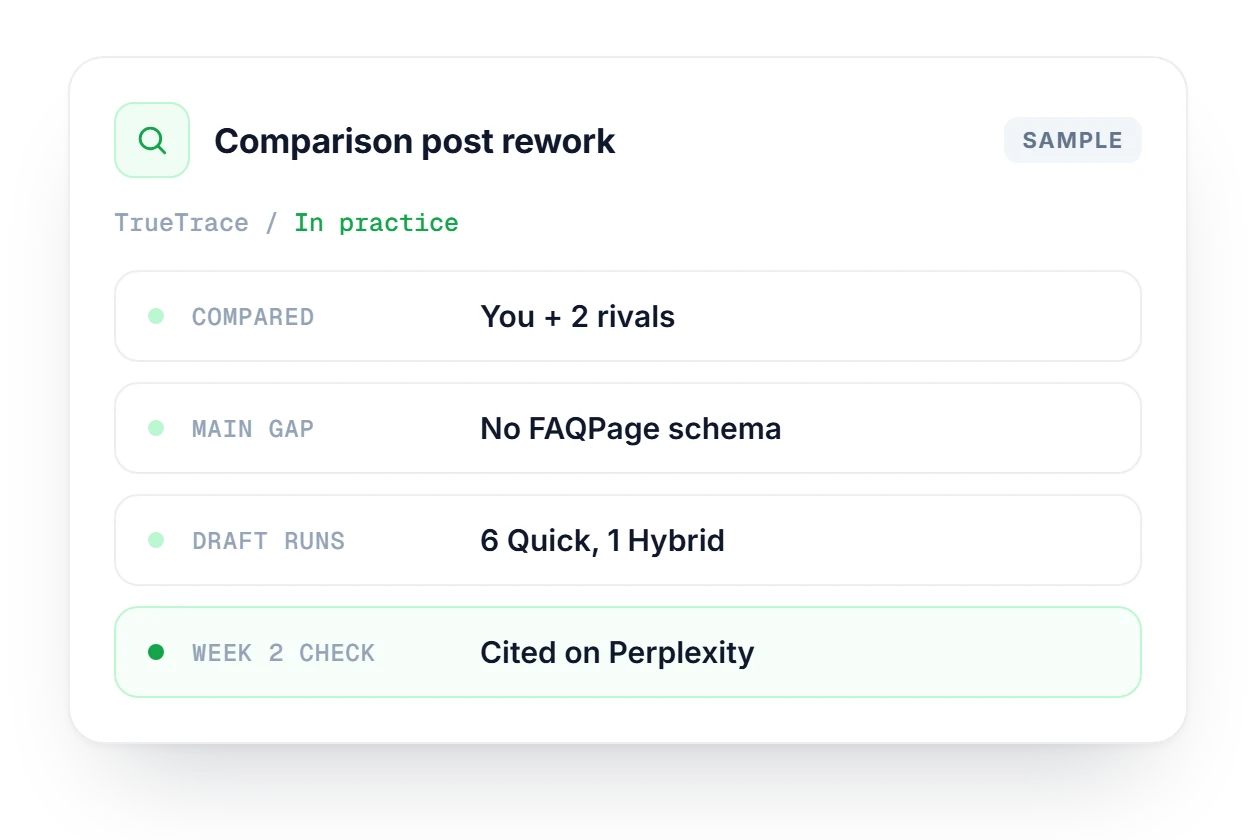
A rival's comparison post keeps showing up in Perplexity answers for "best CRM for startups" and yours doesn't. Competitor Comparison runs both pages through the same 20 factors, and the gap is usually dull, like missing FAQPage schema. Run Quick audits on each draft and Hybrid on the final page, then log whether the engines cite you two weeks later.
Finds queries in your tracked keywords where competitors get cited and you don't. TrueTrace then tells you why.
Explore Citation GapTrack your brand's mentions and position in ChatGPT, Claude, Gemini and Perplexity over time.
Explore AI TrackingFix the technical issues that stop crawlers, from search engines and answer engines alike.
Explore SEO AuditShort answers on how TrueTrace scores pages, compares them and builds reports.
Check which plan includes Hybrid mode and what else comes with it.
Compare plans →Quick runs 20+ static heuristic signals in 2–5 seconds. It's free and fast enough for regular use. Hybrid adds live ChatGPT queries and takes 5–10 seconds. Use it when you need higher-confidence, validated recommendations.
It tests ChatGPT, Claude, Gemini and Perplexity. The multi-LLM matrix shows a score for each engine plus consensus and stability, so you can see where the models agree and where they split.
It's a weighted combination of the 20 factor scores across four pillars: content, technical, authority and readability. Your Quick Wins count and AI Mention Probability also factor in.
Yes. Competitor Comparison mode takes up to 3 URLs and runs the same audit on all of them at once. Because the checks are identical, the scores line up and the comparison is fair.
They answer different questions. TrueTrace scores how citable a single URL is. Citation Gap uses your tracked keyword data to find the queries competitors win and you don't, and TrueTrace then explains why.
A print-ready PDF with an Executive Summary, Priority Actions and the full 20-Factor Analysis, plus a CSV of every factor score for spreadsheets or BI tools. You can assign audits to projects to keep them organized.
After you publish fixes, tell TrueTrace whether an AI engine actually cited your page: Yes or No, the platform and the query. That feedback calibrates the confidence multiplier used on future audits.
Your first TrueTrace audit is free. No credit card, no setup. Paste a URL and you'll have a score.