Does an AI Overview appear?
Every tracked keyword gets a plain Yes or No, checked for you on each run. Right now this is the SERP feature we'd watch first.
SERP AI Tracker pulls the Google results for each keyword, checks for an AI Overview and finds where your domain sits in its sources. Your organic position and the competitors cited alongside you share the same row.
Sample SERP check for illustration
When an AI Overview sits on top of the results, a citation inside it can be worth as much as your organic position. Most rank trackers only report the organic half.
Every tracked keyword gets a plain Yes or No, checked for you on each run. Right now this is the SERP feature we'd watch first.
When an AI Overview cites you, you see your position in its source list. Being the first source is a very different result from being the third.
A pie chart shows how many of your tracked keywords have an AI Overview, and how many of those cite you.
Each check fetches the SERP and the AI Overview for every keyword, then sorts the results into four views.
Classic Google position and AI Overview presence for every keyword in one table, so you are not flipping between two tools.
| Keyword | AIO | AI src | Organic | Also in AIO |
|---|---|---|---|---|
| best crm for startups | Yes | #2 | #4 | rival-one.com |
| crm pricing comparison | Yes | – | #7 | rival-two.io+1 |
| what is a sales pipeline | Yes | #1 | #2 | rival-one.com |
| crm login | No | – | #1 | – |
| crm for small teams | Yes | #3 | #9 | rival-two.io |
The share of your tracked keywords that trigger an AI Overview, split into the ones that cite you and the ones that don't.
Which competitors appear in AI Overviews for the keywords where you don't, named one by one, keyword by keyword.
| Keyword | You | rival-one | rival-two | rival-three |
|---|---|---|---|---|
| best crm for startups | ||||
| crm pricing comparison | ||||
| what is a sales pipeline | ||||
| crm with email sync | ||||
| crm for small teams |
Your target domain, up to 5 competitors and up to 50 keywords stay saved, so the next check is one click.
Organic rank is your spot in the blue links. AI src rank is your URL's spot in the AI Overview's list of sources. The two move on their own, so a page can rank fourth and still be the second source Google's AI quotes.
Your usual Google position, #1 to #10 and beyond.
Your place in the AI Overview citation list, if you're cited at all.
Add your target domain, up to 5 competitor domains and up to 50 keywords, one per line. Then click Save keywords.
SERP and AI Overview data comes in for each keyword, and the table and pie chart fill in as it does.
Note which keywords have AI Overviews, where you are cited and which competitors appear. Re-run the check to see what changed.
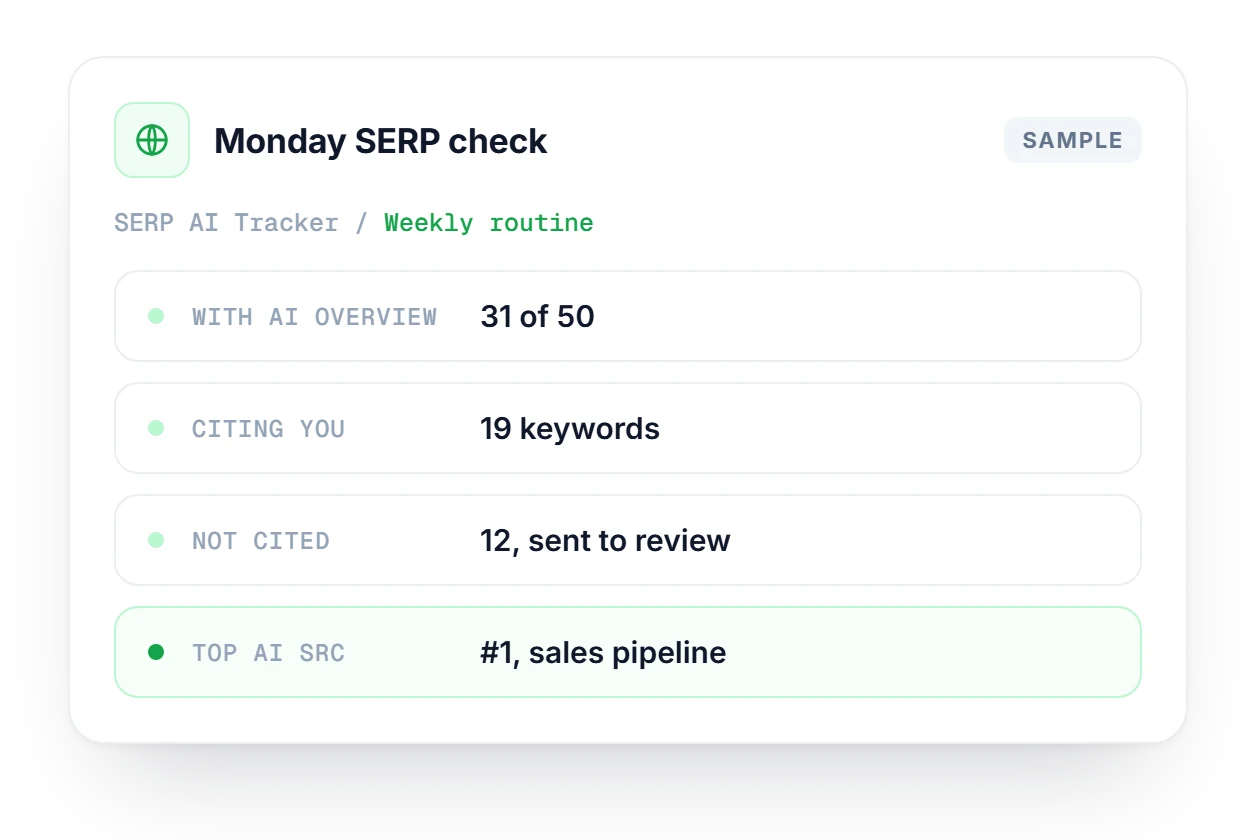
A SaaS marketer runs the Monday check on 50 saved keywords. This week 31 show an AI Overview and 19 of those cite yourbrand.com, so the 12 that quote someone else get compared against the competitor matrix. The pricing comparison keyword goes to Citation Gap, and next week's one-click check shows whether it moved to cited.
Compare Google and AI search volume first, then decide which keywords go into your SERP checks.
Explore Keyword ExplorerFound a keyword where a rival gets cited and you don't? Citation Gap tells you why and puts the fixes in order.
Explore Citation GapOrganic positions synced from Google Search Console and tracked over time across your whole site.
Explore Keyword RankingsHow SERP AI Tracker reads Google's AI Overviews, and how it differs from our LLM tracking.
See which plan fits the number of keywords and competitors you want to track.
Compare plans →It means checking whether Google shows an AI Overview for each keyword and which URLs it cites. We pull each keyword's SERP, detect the AI Overview if there is one, then parse its sources, including your URLs and your competitors'.
You can track up to 50 keywords per configuration. Enter them one per line along with your target domain and competitors, and the list is saved, so every later check runs on the same keywords until you change them.
You can compare against up to 5 competitor domains. They're saved with your target domain and keyword list, so re-running a check takes one click, and the competitor presence view shows which of them each AI Overview cites.
Weekly is a good default. AI Overviews appear and disappear with no warning, and a weekly check gives you a trend you can read. For the few keywords where a lost citation would really hurt, check more often.
Organic rank is your classic position in the blue-link results, from #1 to #10 and beyond. AI src rank is where your URL appears in the AI Overview citation list. They are separate placements and often differ for the same keyword.
They watch different places. Track Keywords monitors your brand mentions across LLMs like ChatGPT, Claude, Gemini and Perplexity. SERP AI Tracker looks only at Google's AI Overview and your organic rank. It's a separate product measuring a separate signal.
Add your domain, a few competitors and your keywords. The first check is free and runs with one click.
 GSC synced