Collections launch every week
Schema, faceted URLs and internal links rarely stay consistent from one drop to the next. One template bug can hit an entire category.
Keep collection and product pages fast and properly marked up, so they show up in Google and in the AI answers shoppers ask for recommendations, sizing help and "best of" lists.


 ChatGPT recommends
Sample store data for illustration
See how the assistants shoppers use describe your products
ChatGPT
 Claude
Gemini
Perplexity
Claude
Gemini
Perplexity
 Search Console
New drops, marketplace resellers and a growing stack of apps all change how search engines and assistants see your catalog, usually without anyone noticing.
Schema, faceted URLs and internal links rarely stay consistent from one drop to the next. One template bug can hit an entire category.
Marketplace sellers copy your product descriptions, and sometimes the AI summary for your own product cites them instead of you.
Each new app adds scripts. Core Web Vitals slip, and paid media hides the damage until margins start to shrink.
Audit the templates behind your collection and product pages, tie them to Search Console queries, and watch how assistants describe your catalog.
Validate the structured data on your product templates so rich results and assistants read prices, availability and reviews correctly. One fix to a template repairs every SKU that uses it.
Track the prompts shoppers ask about your brand, materials, sizing and ethical claims. See if assistants name your store, a marketplace or a competitor.
Connect Search Console and filter by directory to see which queries reach each collection. Merchandisers get SEO data in terms of the categories they actually manage.
Know when a theme or app update breaks schema across the site or slows your templates, so revenue teams can react before paid ROAS starts to fall.
Basic tools give you a list of problems. Linkstonic ties them to the URLs that hold your stock and the answers shoppers read.
Spreadsheets, spot checks and one-off audits.
Audits, Search Console and AI in one place.
"Why did organic drop?" escalations after every app install.
Growth and platform teams share one view, and peak weekends start without all-night audits.
Start freeStart with your main store. Include regional domains or subdirectories if you sell across borders.
Check the health of your collection and product templates, then map money categories to the queries that reach them.
Track assistant prompts next to organic data, and share dashboards with merchandising and lifecycle marketing.
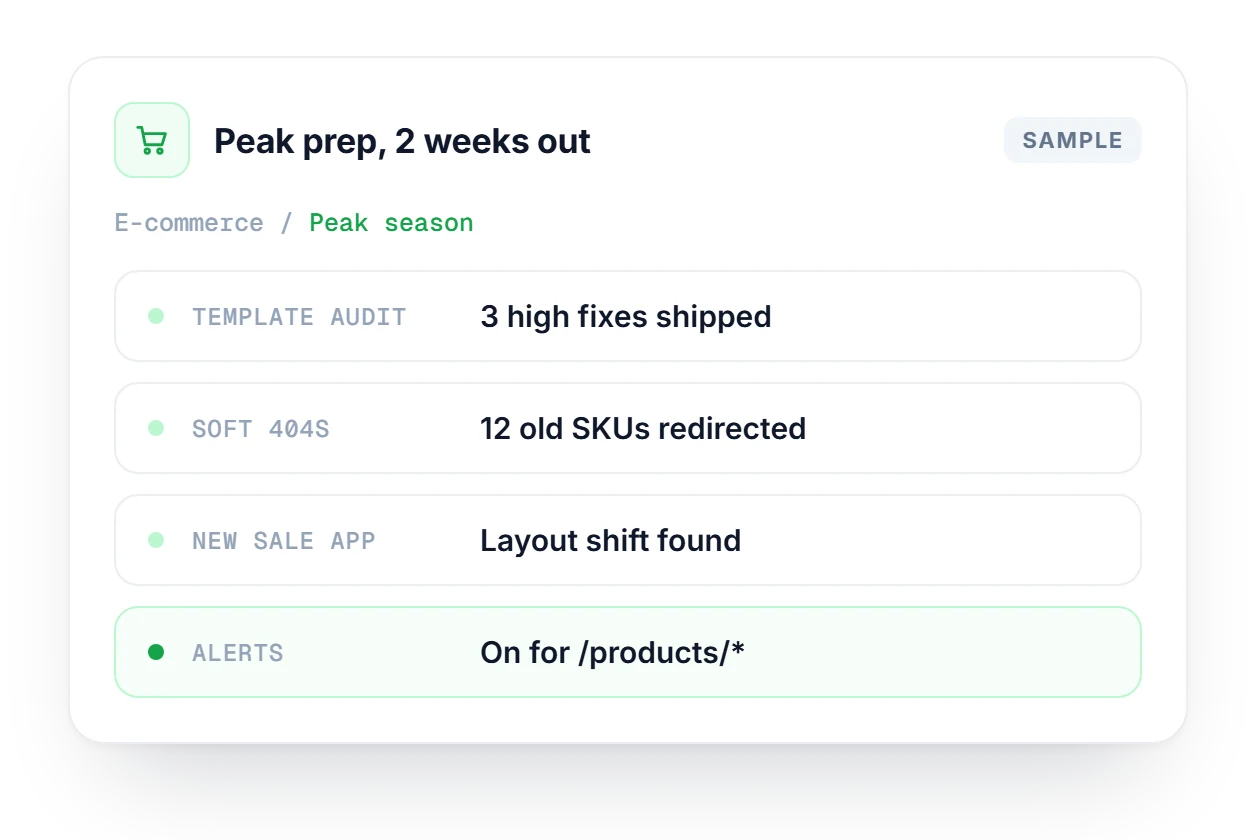
Two weeks before the sale, you audit the product and collection templates and fix everything marked high, including soft 404s on discontinued SKUs. After each new sale app, Real User Monitoring checks /products/* for JS errors and layout shifts. During sale week, alerts stay on for the product template and you read Search Console by directory.
Technical checks with fix guidance for the templates behind your collection and product pages.
Explore SEO AuditSee who AI recommends in your category, and how your share of mentions compares with marketplaces and rivals.
Explore Brand MonitorA lightweight snippet shows the JS errors, failed requests and layout shifts real shoppers hit after an app install.
Explore RUMHow Linkstonic fits alongside your storefront platform, ad tools and agency.
The Agencies solution covers portfolio workflows across many storefronts.
See Linkstonic for agencies →Yes. Linkstonic works from your public URLs, so any storefront platform is supported. Point it at your domain and it audits the templates behind your collection and product pages. Platform-specific apps may come later.
Yes. Tag priority URLs or whole directories such as /collections/ and your dashboards focus on the pages that matter most to revenue. On a large catalog that keeps the view readable: best-selling categories up front, the long tail out of the way.
No. Linkstonic focuses on your own site in organic search and AI answers, and shopping feeds and ad management stay in your ad tools. It can still tell you whether the product pages those ads land on are fast and correctly marked up.
Audits flag soft-404s and redirect problems on discontinued or out-of-stock SKUs, so you keep the authority those pages built up. A common fix is pointing a retired product straight at its closest replacement or parent category, not through a chain of redirects.
Yes, per region. Track each store by domain or subdirectory. Hreflang checks keep regional signals clean and catch duplicates across stores, which matters when your /uk/ and /de/ stores sell the same products with near-identical copy.
Yes. Pair it with the Agencies solution to run the same workflow across a portfolio of stores. Each store is its own property with its own audits, Search Console data and prompt tracking, so one client's numbers don't mix with another's.
Audit your store templates, connect Search Console and start tracking the prompts your shoppers ask. Compare commerce-friendly plans on Pricing.
Our customers
Linkstonic for our team has been a game-changer. It’s helped us work more efficiently, cutting down on manual checks so we can focus on what really matters—measuring AI visibility, fixing technical SEO, and driving growth.
+373%
Increase in
share of voice
 Discord