Keyword-Rich Domain Suggester
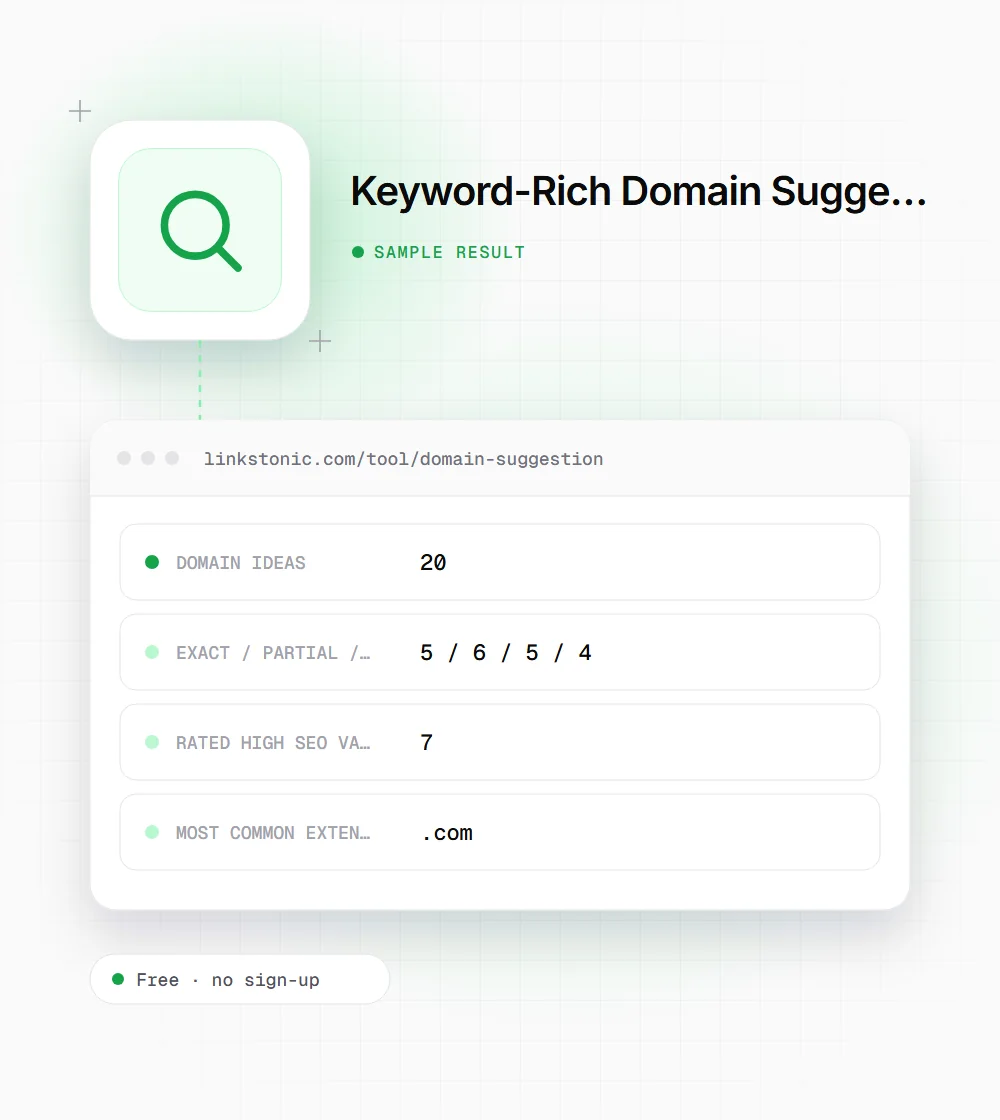
Type a niche or keyword, such as dog grooming or travel blog, and get about 20 domain name ideas. Each is labeled by type with a rough SEO value rating. Availability isn't checked, so confirm with a registrar before you get attached to one.
Updated · by the Linkstonic team
How the suggestions are labeled
Every idea carries a type badge and an SEO value badge. The types matter more than the rating, so start there.
Exact match
Exact suggestions are built almost entirely from your keyword. They're instantly clear about the topic, but in popular niches the good ones were registered long ago, and a name that is only the keyword gets awkward once the business grows past it.
Partial match
Partial names pair the keyword with another word, such as a place, an audience or a modifier. They keep the topic obvious while leaving room to stand out, and in my experience they're the most practical type on the list.
Branded and creative
Branded names are brandable words with little or none of the keyword in them. Creative ones play with the keyword through blends, puns or altered spellings. Both are easier to remember and to protect as a trademark than a generic phrase.
SEO value rating
The high, medium or low badge is the AI model's view of how clearly the name signals the topic. It isn't a measured ranking effect. Google cut back the advantage of exact-match domains with its 2012 EMD update, so treat a high rating as a tie-breaker at most.
What it doesn't check
The list is generated by an AI model on Linkstonic's server. It doesn't query registrars, WHOIS or trademark databases, so some names will be taken and a few may clash with existing brands. Copy all puts one domain per line, ready for a bulk availability search.
Ideas for a local service
An illustrative run. The model writes a new set each time, so the mix of types will shift.
dog grooming
Most of the high ratings land on exact and partial names, because those carry the keyword. The branded names rated low are often the better long-term pick, since nobody else in town can claim the same name.
Who uses a domain suggester
Naming usually happens once, under time pressure, which is when a long list of options helps most.
New business owners
When the obvious name is taken, twenty alternatives in different styles get you unstuck. Shortlist three, say them out loud to a friend, and check which one they can type back correctly.
Bloggers and niche site builders
A partial match name tells readers what the site covers without locking you into one narrow keyword. It's a reasonable middle ground for a site that may widen its focus later.
Agencies and freelancers
Campaign microsites and client side projects need names quickly. The list gives you options to present in a meeting, grouped by style, so the client can react to a direction rather than to one name.
People buying an expired domain
If you're weighing a domain that's already for sale, run its keyword here to see the alternatives. Sometimes a fresh partial-match name is a better bet than paying a premium for an old one with unknown history.
Rules every domain name has to follow
A suggestion can be clever and still break a technical rule. These apply to every registration.
| Rule | Limit | In practice |
|---|---|---|
| Label length | 1 to 63 characters | The part before .com can't run longer than 63 |
| Full name length | 253 characters | Only matters with long subdomains |
| Allowed characters | Letters, digits, hyphens | No spaces, underscores or symbols |
| Hyphen position | Not first or last | A label can't start or end with a hyphen |
| Letter case | Not case-sensitive | DogShop.com and dogshop.com are the same name |
| Non-Latin scripts | Allowed as IDNs | Stored as xn-- Punycode behind the scenes |
Registries can add their own rules on top, such as minimum lengths or local presence requirements for some country-code domains.
Do keywords in a domain still help?
Less than many people think. Google's 2012 exact-match domain update targeted low-quality sites that ranked mostly because of a keyword-stuffed name, and Google has since said a keyword in the domain doesn't give a meaningful boost. A keyword can still tell people what you do before they click, and that has some value.
The mistakes we see are practical ones. Names with two hyphens look spammy in search results. Names that are hard to spell out loud lose word-of-mouth visitors. Names tied to one product get awkward when the business adds a second. Say each shortlisted name to someone and ask them to type it.
AI assistants add a new angle. When ChatGPT or Gemini recommends a business, it usually names the brand, not the URL. A distinct name used consistently across your site, profiles and mentions is easier to connect back to you than a generic keyword phrase that dozens of similar sites also use.
Before you register
A few minutes of checking now saves a rebrand later.
- 01
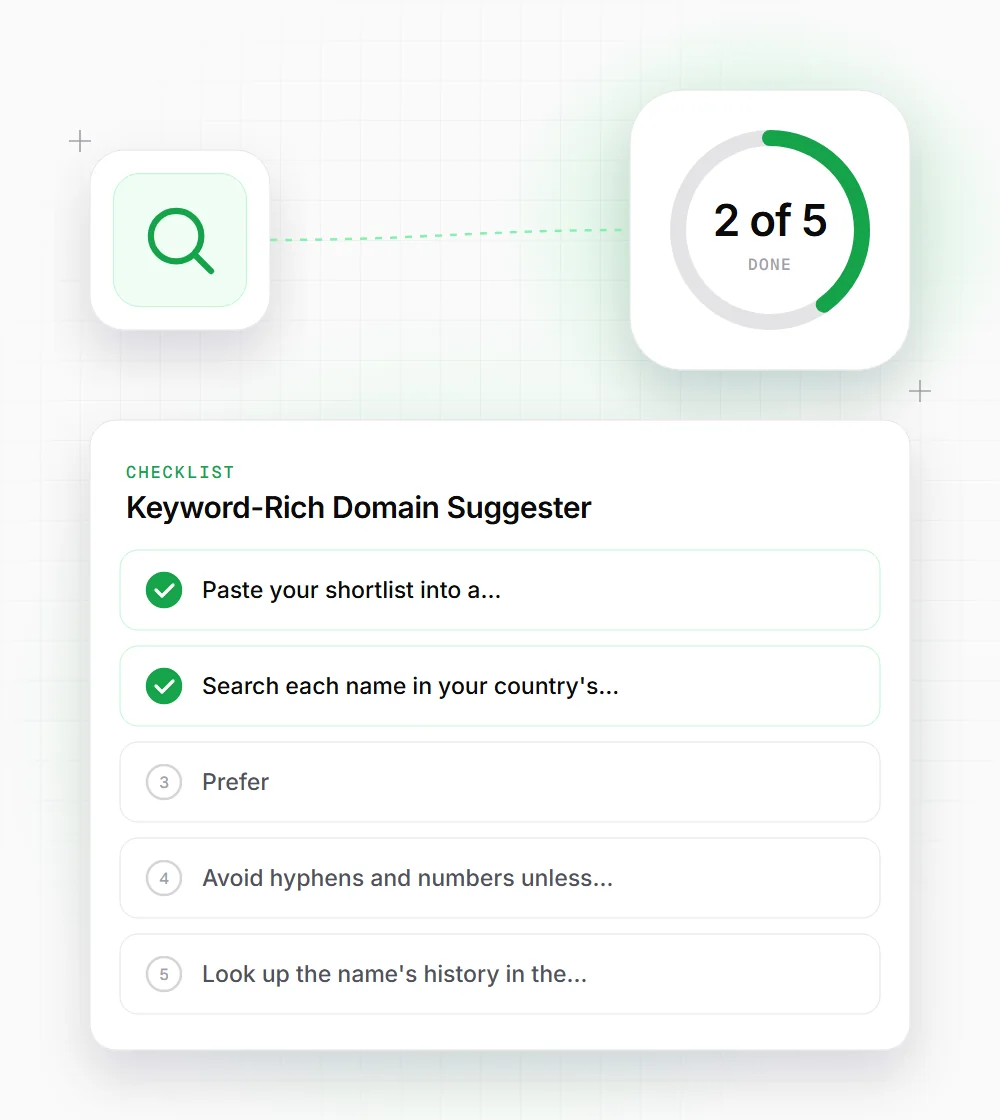
Paste your shortlist into a registrar's bulk search. Copy all gives you exactly one domain per line for that.
- 02
Search each name in your country's trademark database and on the social platforms you plan to use.
- 03
Prefer .com or your country code if customers are local. People tend to type .com by habit when they misremember an extension.
- 04
Avoid hyphens and numbers unless they're part of the brand, because both cause errors when people type from memory.
- 05
Look up the name's history in the Wayback Machine. A domain with a spammy past can carry that baggage with it.