AI Detector
Paste a paragraph, an essay or a full article and the detector returns an AI probability from 0 to 100%, a plain-language verdict and a list of the patterns it picked up. Treat the result as a reason to look closer, not as proof.
Updated · by the Linkstonic team
What the detector gives back
The analysis runs on Linkstonic's server, not in your browser. Each check returns the same few pieces, and each one answers a slightly different question.
The verdict
Every check lands on one of five labels: human-written, likely human, mixed, likely AI or AI-written. The result card turns green for the two human labels, amber for mixed, orange for likely AI and red for AI-written, so the answer is readable at a glance.
AI probability
The large number is the tool's estimate, as a percentage, that a language model wrote the text, with a bar filled to the same width. It's an estimate, not a measurement. A text at 55% and one at 62% aren't meaningfully different, so don't compare scores to the point.
Signals detected
Under the score sits a bulleted list headed "AI signals detected": the patterns the analysis found in your text. I'd read this list before the number. It tells you which habits in the writing drove the result, and that is the part you can act on.
Explanation
When the server returns one, a short explanation appears under the verdict. It says in words why the text landed where it did. That's handy when you have to pass the result to someone who won't open the tool themselves.
It's a heuristic
The tool labels its own result a heuristic estimate that isn't 100% accurate, and that's fair. Formal writing, short samples, lists and text by people writing in a second language are common sources of false positives. A careful human who writes tidy, even prose can score high.
How much to paste
The form has no minimum length, and the Detect AI Content button turns on as soon as the box has any text. In practice, give it a few paragraphs at least. One or two sentences carry too little pattern for any detector to judge fairly.
A sample check
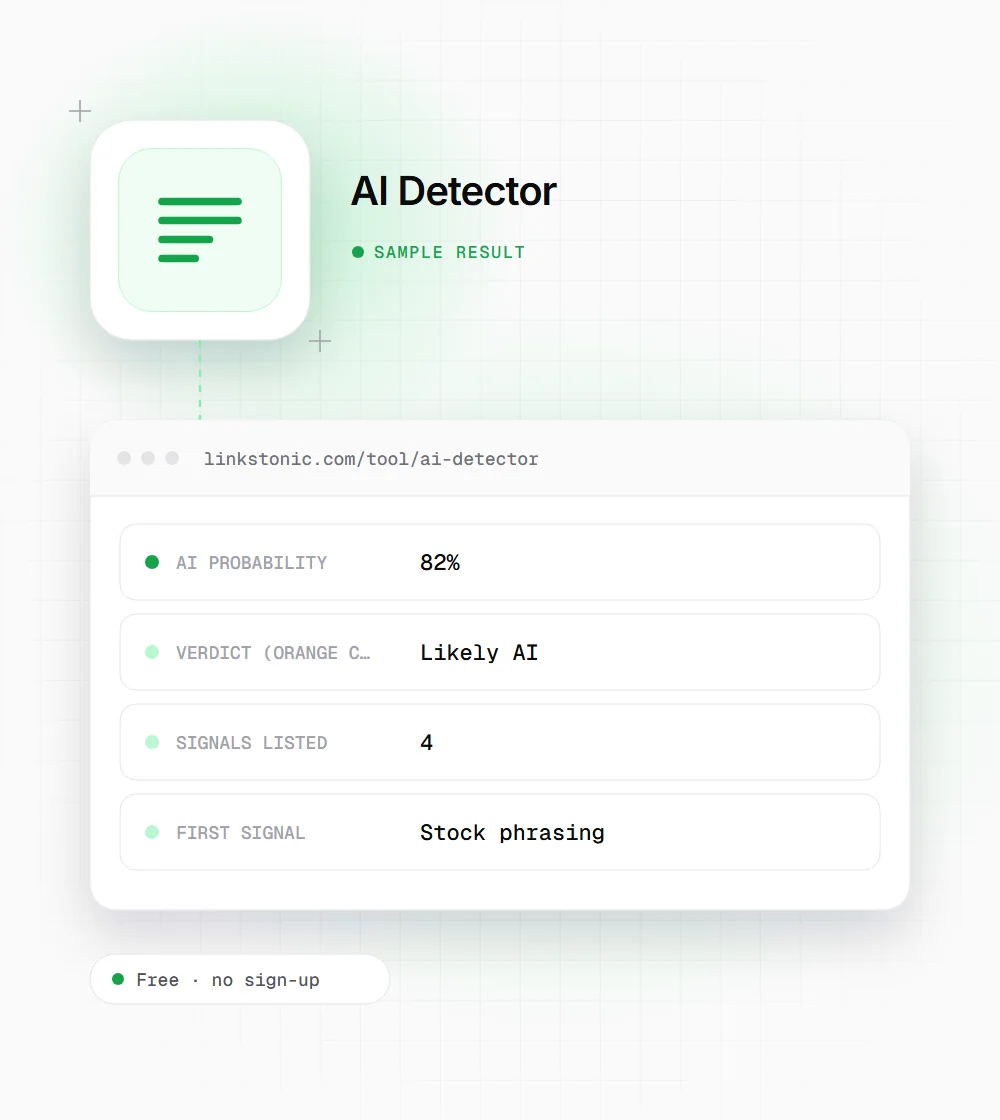
An illustrative result for a stock paragraph from a marketing blog. Your numbers will differ with the text you paste.
In today's fast-paced digital world, businesses must adapt to stay ahead. Effective email marketing is essential for driving engagement and fostering lasting customer relationships. By leveraging personalized content, brands can unlock new opportunities and achieve sustainable growth.
Nothing in the paragraph is wrong. It scores high because every sentence is generic, roughly the same length and could sit on any company's blog, which is the kind of pattern the signals list calls out.
Who runs text through it
Different people come with different stakes. The same score means something different to each of them.
Teachers and tutors
A high score on an essay is a prompt for a conversation, not a grade. Ask the student about their sources, their notes and an earlier draft. Detector output is not reliable enough to decide a misconduct case on its own.
Writers checking their own work
If your own draft reads as AI, the signals list shows why. It's often rhythm: sentences of similar length and shape, one after another. Fixing that makes the piece better to read, whatever a detector thinks of it.
Hiring managers
Cover letters and writing samples are easy to generate now. A check can tell you which ones deserve a follow-up question in the interview, such as asking the candidate to talk through a point they made.
Curious readers
Product reviews, forum answers and LinkedIn posts that feel oddly smooth are a common reason people land here. The verdict won't settle it, but the signals list is a useful way to think about why a text felt off.
What a detector score can and can't tell you
No detector can prove where a piece of text came from. They look for statistical patterns that language models produce often and people produce sometimes. False positives are part of the deal, and a wrong accusation costs more than a missed AI paragraph. I'd never act on a score alone.
Google's stated position is that it judges content on quality, not on how it was produced. Its guidance says using automation mainly to manipulate rankings breaks its spam policies, while helpful content is fine however it was made. So a high score isn't an SEO problem in itself. Thin, generic copy is, and that copy often shows the same patterns the detector flags.
AI answer engines add a twist. ChatGPT, Perplexity and Google's AI Overviews need something concrete to quote: a number, a first-hand test, a clear definition. Generic text that reads as machine-made rarely has any of those. Editing to lower a detector score and editing to be worth quoting turn out to be mostly the same job.
Bringing a high score down honestly
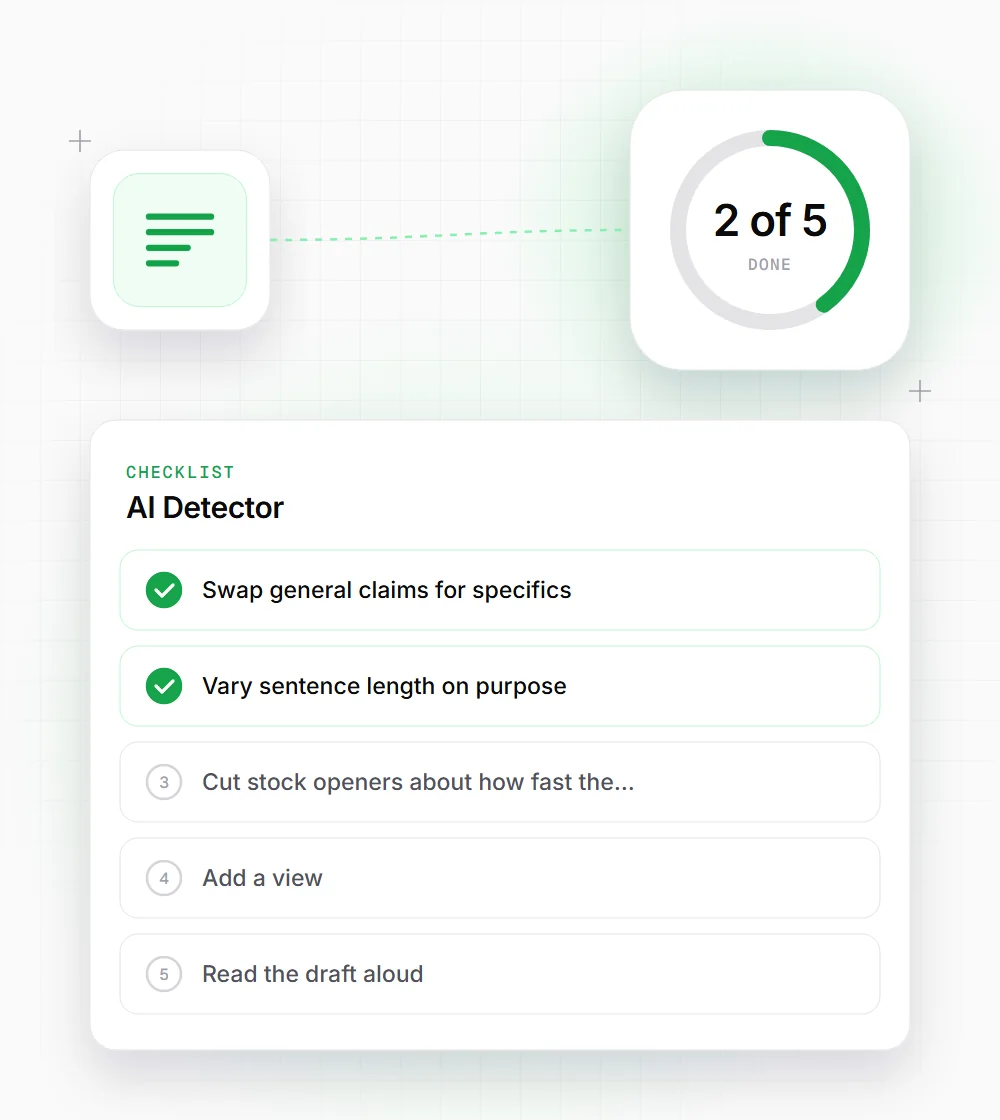
If your own writing scores high, rewriting is fine as long as the edits make the text better. These ones do.
- 01
Swap general claims for specifics: a figure, a date, a product name or a result you saw yourself.
- 02
Vary sentence length on purpose. Follow a long, detailed sentence with a short one that lands the point.
- 03
Cut stock openers about how fast the world is changing, and closing lines that only repeat what the paragraph already said.
- 04
Add a view. Say what you would do and why, and say so when you disagree with the usual advice.
- 05
Read the draft aloud. Any sentence you wouldn't say to a colleague across the desk is a candidate for a rewrite.