AI Content Detector
Paste a freelance draft, a guest post or an agency deliverable before it goes into your CMS. You get an AI probability, a five-step verdict and the patterns behind it, which gives an editor something specific to raise with the writer.
Updated · by the Linkstonic team
Fitting the check into an edit
The tool returns the same pieces every time: a verdict, a percentage, a short explanation and a list of signals. This is how we use each one when a draft lands on the editing desk.
Check it section by section
There's no minimum length, so you can paste a whole article or a single section. Checking the intro, body and conclusion separately tells you more. A draft that's mostly human with a machine-written conclusion shows up clearly, instead of blurring into one middling score.
Treat the verdict as triage
The five labels run from human-written through likely human, mixed and likely AI to AI-written, and the card goes green, amber, orange or red to match. We send the two human labels to a normal edit, read mixed drafts closely, and talk to the writer about the last two.
Put the signals in your feedback
The bulleted "AI signals detected" list is what's worth forwarding. "Your score is 74%" starts an argument. Quoting the patterns the tool found, and pointing to where they sit in the draft, gives the writer something concrete to fix.
Know what the percentage is
The AI probability is a heuristic estimate returned by Linkstonic's server, and the tool itself says it isn't 100% accurate. Small differences mean nothing. We pay attention when a writer's new draft scores far above their usual work, not to any single number.
Expect false positives on some briefs
Product specs, legal copy, how-to steps and glossary entries are predictable by nature and can score high even when a person wrote every word. So can writers working in their second language. Check what kind of brief it was before reading anything into the score.
A submitted draft through the check
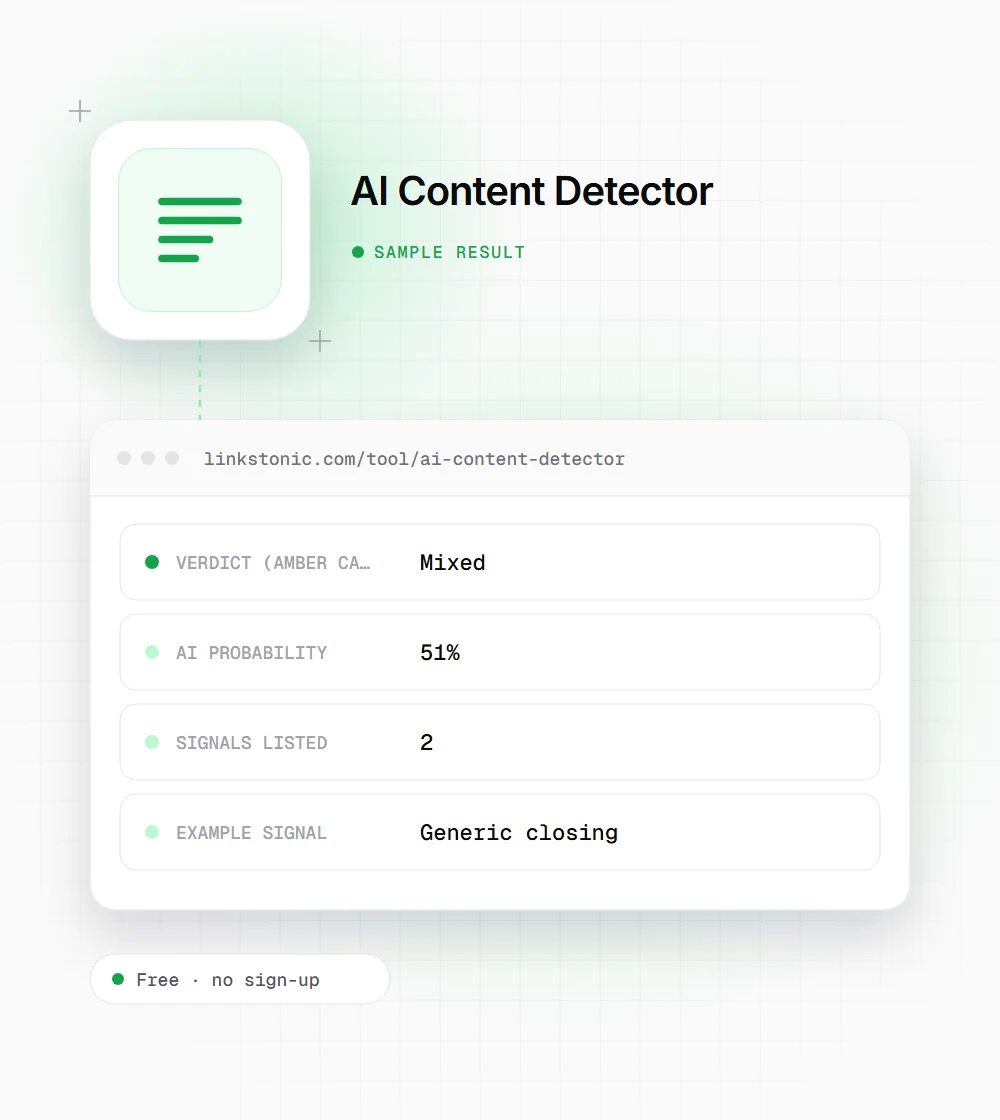
An illustrative result for the opening of a guest post. Real results depend on the full text and will vary.
Remote onboarding is hard. Our team hired 14 people in 2025 without meeting one of them in person, and two of the first hires quit within a month. Here is what we changed. In conclusion, a well-structured onboarding process is key to success in the modern workplace and helps organizations thrive.
The first three sentences carry a number, a year and a failure, which reads as first-hand. The closing sentence could end any article on any topic, and that single line is what pulled the draft toward the middle.
Where it fits in a content operation
Anyone who publishes words they didn't write themselves has a reason to run this check.
Managing editors
Run incoming freelance drafts before the line edit. A high score doesn't reject the piece, but it tells you which drafts need the closest read and which writer to call first, before the deadline gets tight.
SEO and content agencies
Some clients ask directly whether delivered content was written with AI. Checking each deliverable and keeping the result with the brief lets you answer with more than your word, and catches problems before the client does.
Guest post and outreach teams
Guest posts offered in exchange for a link are often spun or generated. Screening them before they reach your site keeps thin pages off your domain and saves an editor from rewriting someone else's filler.
Teams that use AI on purpose
If your process uses AI for first drafts, the check confirms that the human edit actually happened. A draft that still reads as fully AI-written after editing hasn't had enough of a human pass yet.
Writing an AI policy your editors can apply
Plenty of content teams use AI somewhere, so a flat "no AI" rule rarely survives contact with a deadline. A policy that works says where AI help is fine (outlines, research notes, first drafts) and what has to come from a person (claims, examples, opinions, the final edit). The detector gives you a rough check on the second part.
Don't turn the score into a contract clause. A freelancer told they fail above 30% will rewrite until the number drops, and that can make the writing worse, not better. Tie payment to the brief and the edit notes, and use the detector to decide where an editor spends their time.
On search: Google has said it evaluates content quality rather than how it was made, so the score isn't a ranking signal. What hurts is the generic copy that tends to trigger it. AI answers work the same way. ChatGPT, Gemini and AI Overviews need something specific to quote, and a draft full of broad statements gives them nothing to pick up.
A pre-publish review routine
This is the order we run it in. It takes a couple of minutes per draft once it's a habit.
- 01
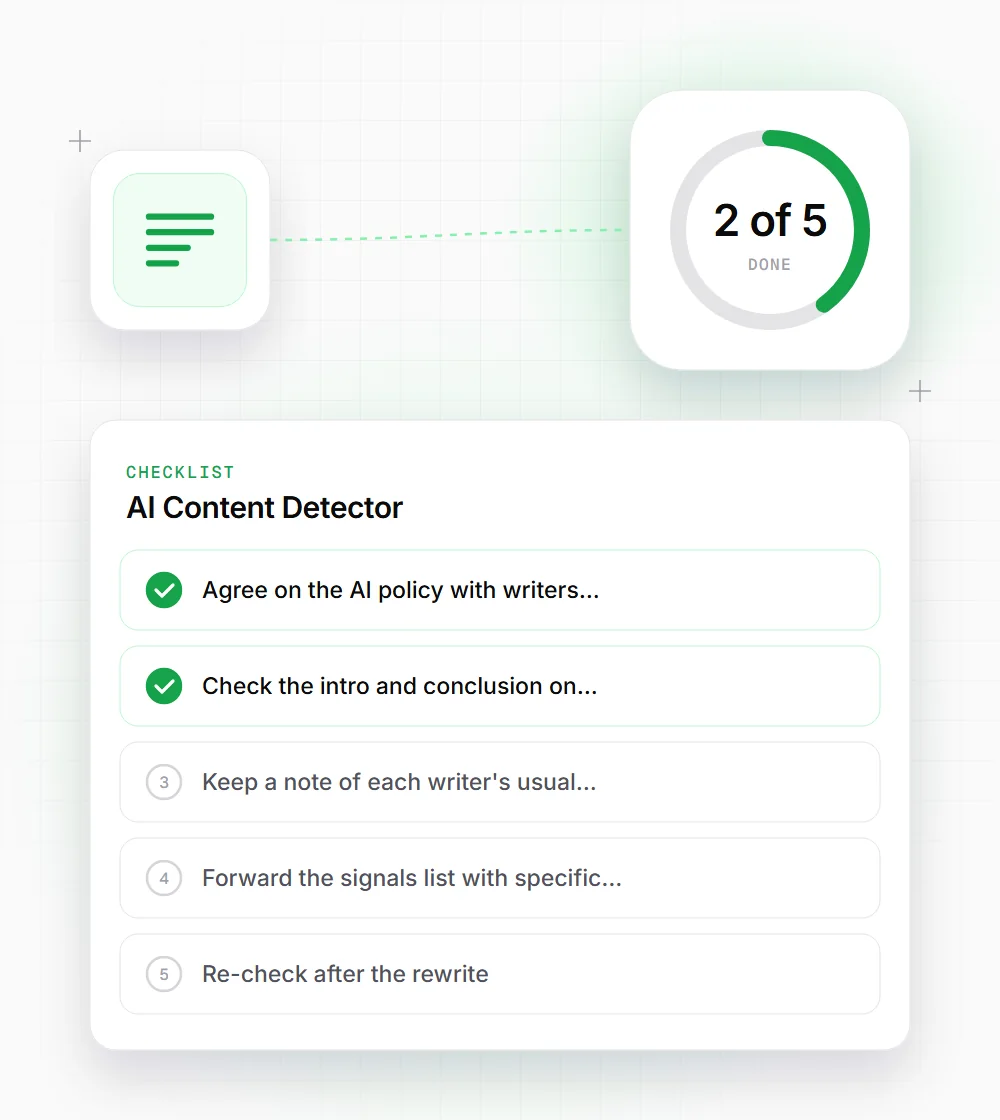
Agree on the AI policy with writers before the first brief, so a check never feels like an accusation after the fact.
- 02
Check the intro and conclusion on their own. Filler tends to collect at the edges of a draft, and it's quick to spot there.
- 03
Keep a note of each writer's usual results. A jump on one draft tells you more than a single high number does.
- 04
Forward the signals list with specific edit requests, and leave the percentage out of the conversation.
- 05
Re-check after the rewrite. If the verdict hasn't moved at all, the edit was probably cosmetic.
- 06
Never reject a draft or withhold payment on a score alone. Ask for notes, sources or an earlier version first.