E-E-A-T Analyzer
Enter the URL of an article, guide or landing page. The tool fetches it, checks 12 on-page signals such as bylines, dates, schema and policy links, and turns the results into four bars for Experience, Expertise, Authoritativeness and Trust.
Updated · by the Linkstonic team
What the 12 checks look for
Google's raters judge E-E-A-T by reading the page and researching the author. A tool can only spot the on-page evidence, so that's what these checks do.
Markup signals
The HTML is searched for author or byline wording, a publish date ("published", article:published_time or a datetime attribute), Article, BlogPosting or NewsArticle schema, Organization or Person schema, and an outline with both an H1 and at least one H2.
Content signals
Body copy passes at 400 words of visible text. The title needs 10 characters or more. External references pass with two or more links whose href starts with http:// or https://, and the final URL must be served over HTTPS.
Trust wording
The visible text is scanned for "about us", "contact", "our team" or "editorial"; for "review", "testimonial", "rating" or "trustpilot"; and for "privacy policy", "terms of", "editorial policy" or "disclaimer". Footer links usually count, so most sites pass the first and last of these.
The shared base
All four bars start from one base: 50 plus 3.5 points per passed check, with that bonus capped at 42. Pass 9 of 12 and the base is 81.5. The dimensions then move up or down from there, and no bar can exceed 98.
How each bar adjusts
Experience adds 6 with 400+ words, or loses 6. Expertise adds 10 when both a byline and Organization or Person schema exist, else loses 2. Authoritativeness adds 7 for external links (else -5) and 4 for a clear title (else -3). Trust adds 8 for reviews plus policies, and 5 for Article schema (else -2).
An illustrative article
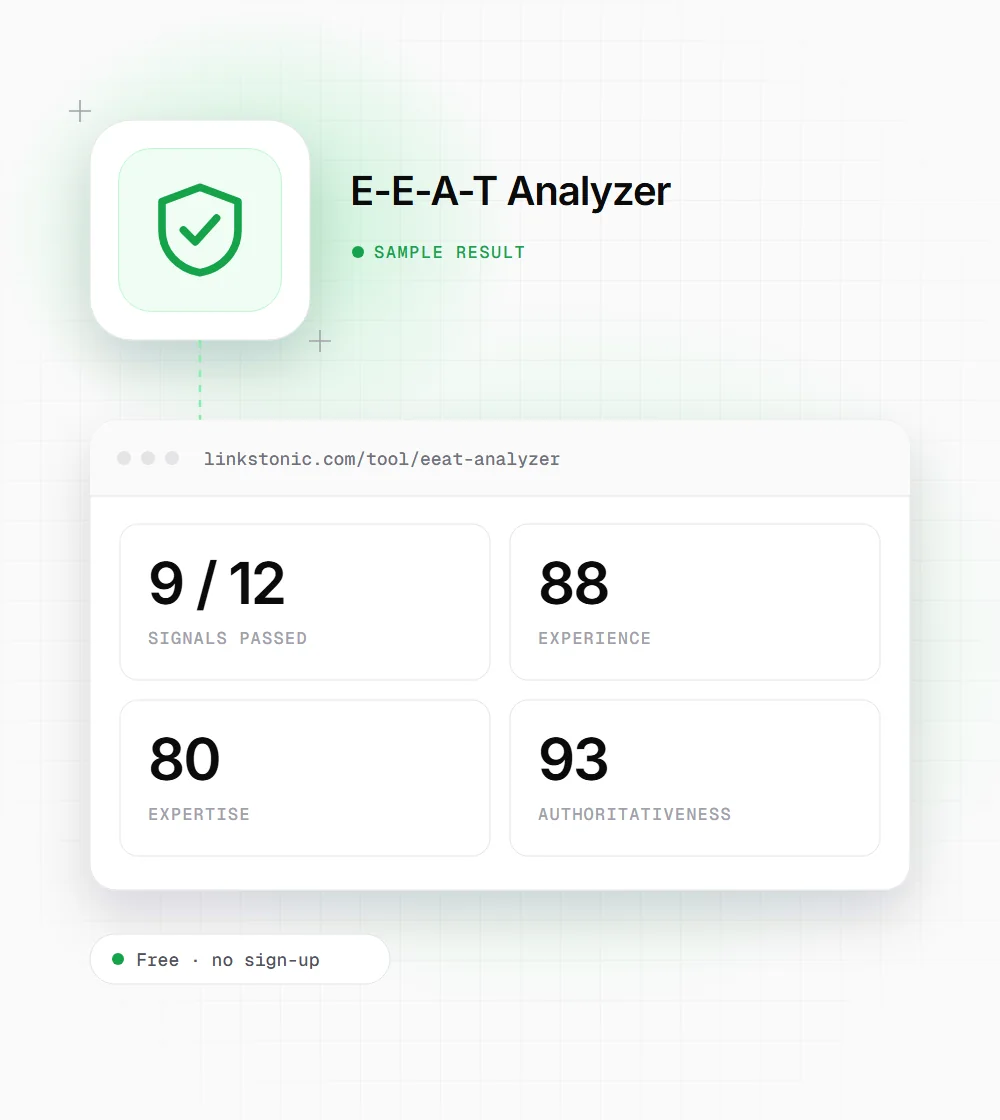
This is an illustrative result for a made-up blog post, worked through the scoring rules. It passes 9 of 12 checks, missing Article schema, Organization or Person schema, and reviews.
https://example.com/blog/how-to-choose-a-standing-desk
Authoritativeness comes out highest even though the page has no schema, because that bar only looks at outbound links and the title. Adding Person schema for the author passes one more check and earns the 10-point byline bonus, taking Expertise from 80 to 95.
Who uses an E-E-A-T check
It won't replace an editorial review, but it catches template gaps in under a minute.
Editors of YMYL content
Health, finance and legal pages get the strictest scrutiny from Google's quality raters. Run each new piece to confirm the byline, date and author schema actually made it into the published HTML, not just the CMS.
Affiliate and review sites
Review pages live or die on trust. The check quickly shows whether a page has a named author, outbound references and visible policies, which are the first things a skeptical reader looks for too.
Agencies onboarding a client
Score five representative URLs on day one. Misses that repeat across all five point to the theme or CMS template, which is usually a single fix that improves every page on the site.
E-E-A-T is a lens, not a score
Google has said plainly that E-E-A-T isn't a single ranking factor. It's the framework its quality raters use to judge whether search results are good, and those judgments shape how ranking systems are tuned. So any tool that hands you an "E-E-A-T score" is really scoring the signals that tend to go with it.
That's still useful. A missing byline, no date and no contact page are real problems for readers, and they're easy to fix. What a tool can't see is whether the author has done the thing they write about, or whether other sites vouch for them. That's the part that matters most.
AI answers lean on the same cues. ChatGPT, Perplexity and Google's AI Overviews prefer sources that are clearly attributed and current, and a page with a named expert, a date and cited references is easier to trust and to quote. I'd treat 90 here as the entry ticket, not the finish line.
Quick fixes for weak bars
Each fix below maps to a specific check, so you can see the bar move on the next run.
- 01
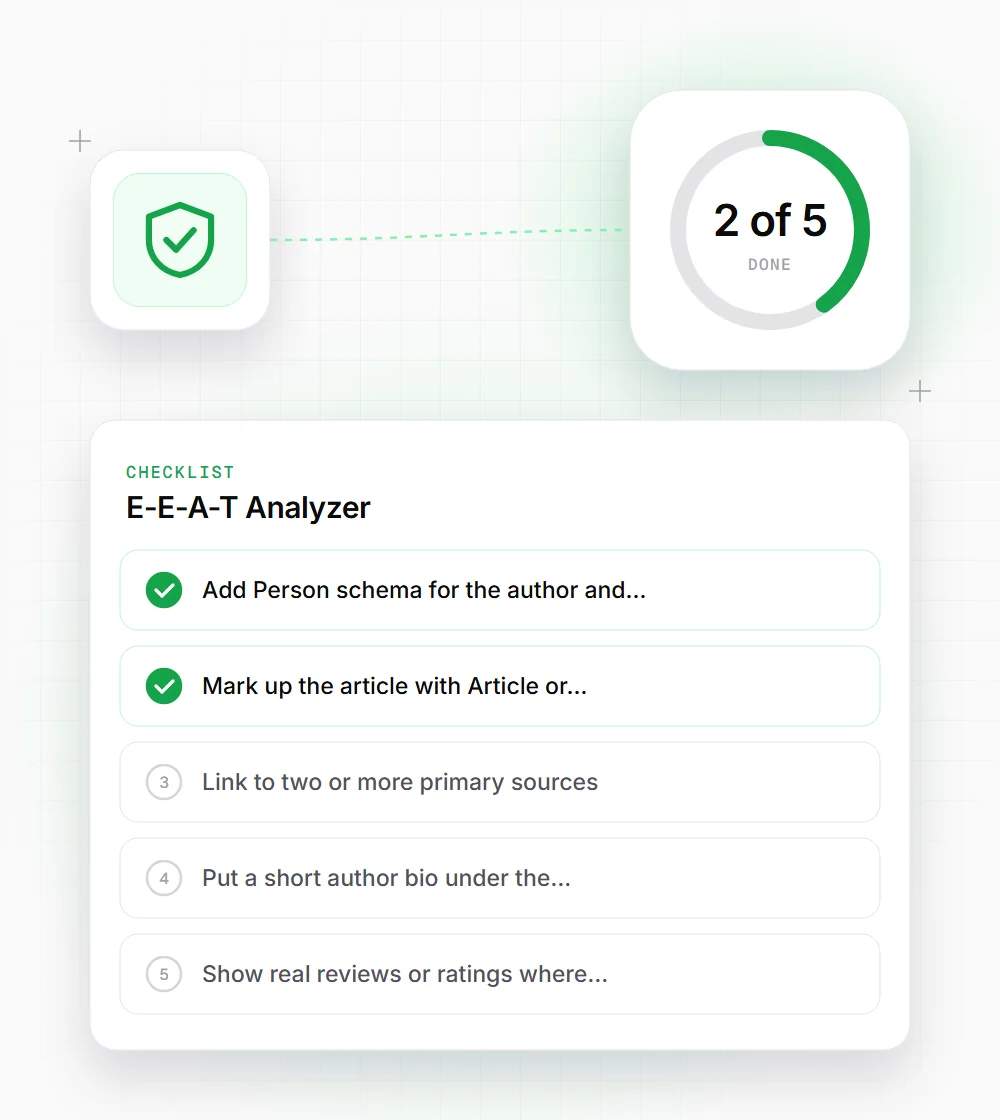
Add Person schema for the author and Organization schema for the site. Together with a visible byline, that's the biggest single jump for Expertise.
- 02
Mark up the article with Article or BlogPosting schema including datePublished. It clears one check and swings the Trust adjustment from minus 2 to plus 5.
- 03
Link to two or more primary sources: studies, official documentation or original data. Linking to your own pages with absolute URLs also passes, but doesn't help readers.
- 04
Put a short author bio under the article with credentials and a link to an author page. The checker can't read credentials, but readers and raters can.
- 05
Show real reviews or ratings where they make sense, and keep privacy and editorial policy links in the footer.