Citation Probability Checker
Enter the URL of an article or guide and the tool fetches the page, then checks eight on-page signals that sources people cite tend to have. You get a pass or miss for each one and a single heuristic score between 28 and 100.
Updated · by the Linkstonic team
How the score is put together
The number looks like a probability, but it's a checklist total. Nothing here queries ChatGPT, Perplexity or Google. It reads the page and counts signals.
Fetching the page
Your URL goes to a Linkstonic server, which fetches the page and returns its final URL after redirects, the visible text and a sample of the HTML. Pages behind a login, a bot wall or heavy client-side rendering may come back thin and score lower than they deserve.
Scoring math
Every page starts at 28. Each of the eight signals that passes adds 9 points, so the possible scores are 28, 37, 46, 55, 64, 73, 82, 91 and 100. All signals weigh the same; outbound links count as much as HTTPS.
Depth and references
"Deep content" passes at 500 words of visible text. "Outbound citations" needs at least two links in the HTML that start with http:// or https://. Those absolute links can include your own navigation, so the check is looser than it sounds.
Reference phrasing
The text must contain "according to", "study", "research", "report" or "source" as whole words. Plurals don't match: a page that only says "studies" and "sources" fails this signal, while one mention of "research" passes it.
Markup checks
Schema passes if "schema.org" appears anywhere in the HTML. The author signal looks for "author", "byline", "organization" or "publisher". Dates look for "published", "datemodified", "article:published_time" or a datetime attribute. The title needs 10 or more characters.
An illustrative result
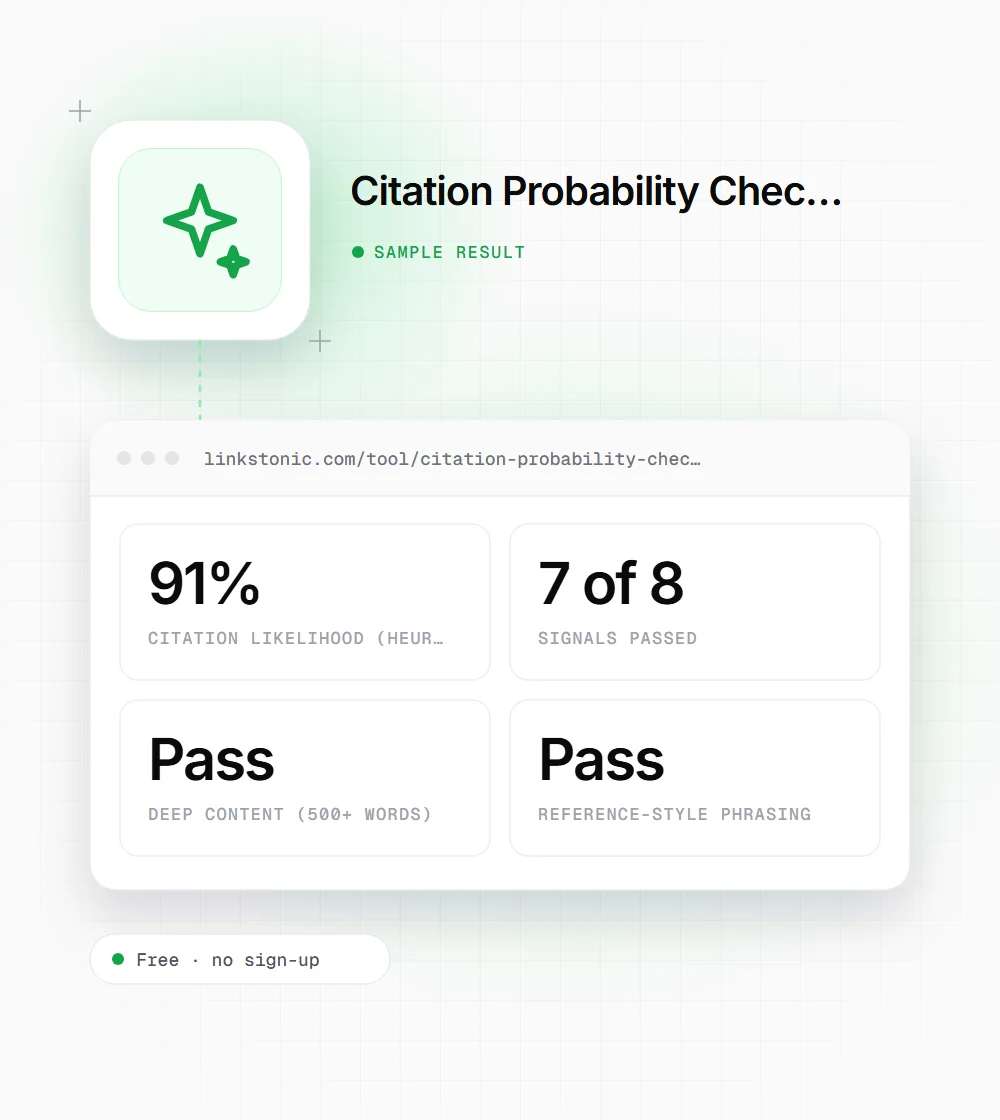
This is an illustrative result for a made-up URL, not a measurement of a real site. It shows how the checklist adds up.
https://example.com/research/remote-work-survey-2026
One missing signal costs exactly 9 points. Adding two links to the survey's original sources would take this page from 91 to 100, which says more about the scoring than about its odds of being cited.
Who runs this check
It's a fast pre-publish pass, not an audit. These are the people who get the most from it.
Content leads
Before a research piece or data study goes live, run the URL on staging or right after launch. If the reference or date signal is missing, it's a two-minute fix while the author is still around.
GEO and SEO consultants
Score a client page and the three competitors that keep showing up in AI answers. The gaps are rarely dramatic, but a missing author or date on the client side is an easy conversation opener.
Publishers with old archives
Older articles often lack schema and modified dates. Spot-check a handful of top traffic URLs to see whether a template change would fix the same misses across hundreds of pages.
The eight signals at a glance
Each row is one line in the tool's checklist, with the exact condition that turns it green.
| Signal | Looks at | Passes when |
|---|---|---|
| HTTPS URL | Final URL | It starts with https: |
| Schema.org markup | HTML | "schema.org" appears anywhere |
| Author or organization | HTML | author, byline, organization or publisher appears |
| Publish or modified date | HTML | A published or modified date cue is present |
| Deep content | Visible text | 500 words or more |
| Outbound citations | HTML links | 2 or more absolute http(s) links |
| Reference phrasing | Visible text | according to, study, research, report or source |
| Clear page title | title tag | 10 or more characters |
Matching is case-insensitive and based on text patterns, so a word in a class name or script can satisfy a markup check.
What a citation score can and can't tell you
Let me be blunt about the name: this doesn't predict whether ChatGPT, Perplexity, Gemini or Google's AI Overviews will cite you. No outside tool can, because the answer depends on the query, the model and what else exists on the topic. What the checker does is catch the basic source hygiene that most cited pages already have.
The signals are cheap to fake, and that's the trap. You can add "according to" and two links in five minutes and hit 100. The pages that actually get cited tend to have something others don't: original data, a clear definition, a named expert, a date that shows it's current.
So I'd use the score as a floor. If a page sits at 46 or 55, fix the misses because they're also things human readers look for. Once you're at 82 or above, stop polishing the checklist and spend the time on the content itself.
Fixing the common misses
Most failed signals come down to template gaps rather than writing problems.
- 01
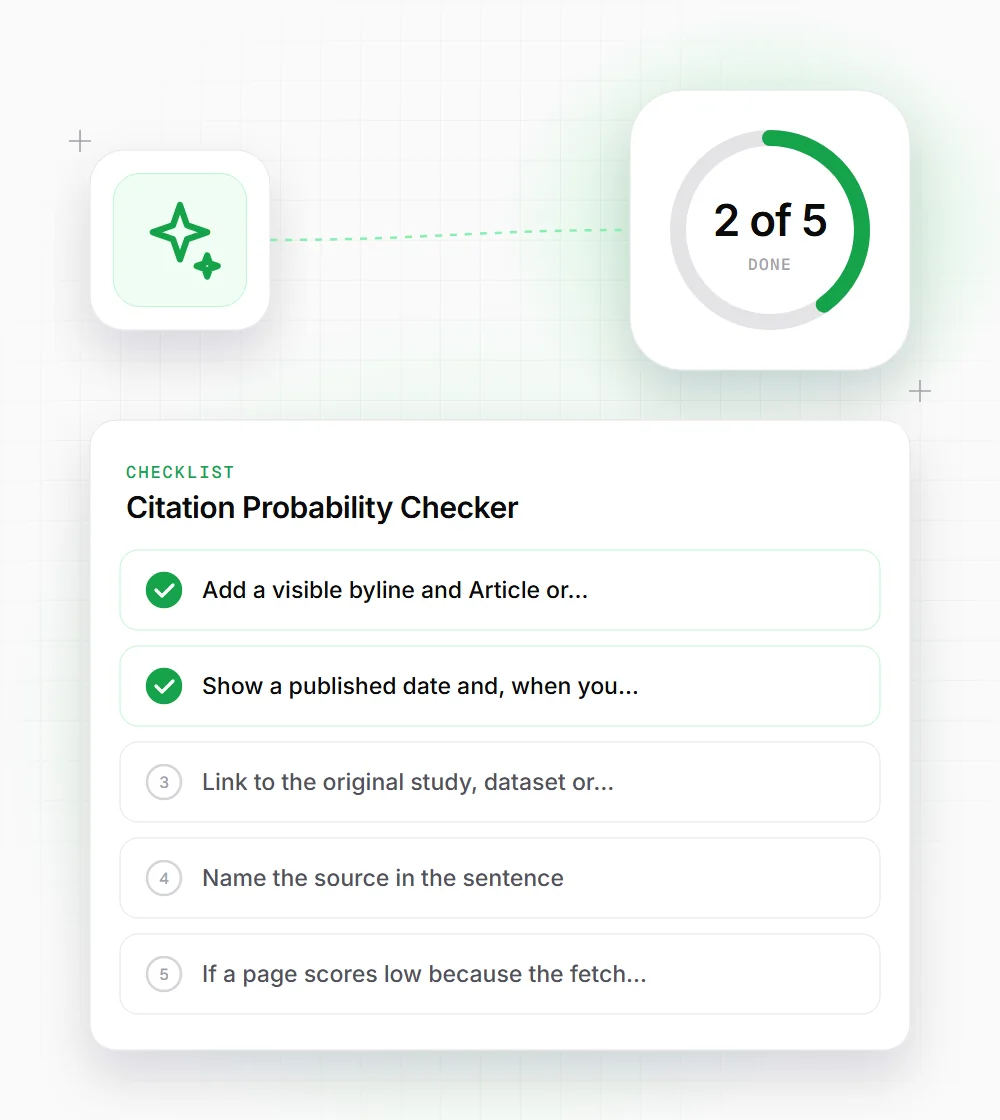
Add a visible byline and Article or BlogPosting schema with an author property. That clears both the markup and author signals in one change.
- 02
Show a published date and, when you revise, a modified date. Use a time element with a datetime attribute so it's machine-readable.
- 03
Link to the original study, dataset or documentation you're drawing on, not just a news story about it.
- 04
Name the source in the sentence: "according to the 2025 census" reads better and passes the phrasing check at the same time.
- 05
If a page scores low because the fetch came back empty, check whether it renders content only with JavaScript or blocks unknown user agents.
- 06
Rerun the check after each fix. Because every signal is worth the same 9 points, you can see exactly which change moved the score and by how much.