Readability Checker
Paste a paragraph or a full article body and get a Flesch Reading Ease score with a plain-English band, a Flesch-Kincaid grade level, word and sentence counts, and a rough passive-voice count. It all runs in your browser, so the text stays on your machine.
Updated · by the Linkstonic team
How the scores are worked out
Both formulas depend on three counts: words, sentences and syllables. The checker makes quick, mechanical choices for each, and those choices explain most of the odd results people see.
Words
A word is a run of letters and apostrophes. Numbers are ignored, so "50,000 URLs" counts as one word. Hyphens split words: "well-known" is two. On data-heavy copy the word count will sit lower than a normal word counter shows.
Sentences
The text is split on periods, question marks and exclamation points, and empty pieces are dropped. The dots in "e.g.", a decimal like 3.5 or a domain name each start a new sentence. Bullet lists with no end punctuation are read as one very long sentence.
Syllables
Words of three letters or fewer count as one syllable. Longer words count groups of vowels (y included), minus one if the word ends in e, with a floor of one. So "planned" and "mapped" count as two syllables, and "table" counts as one.
Reading ease
206.835 minus 1.015 times words per sentence, minus 84.6 times syllables per word. The result is capped between 0 and 100 and rounded to one decimal. Higher is easier. The band label under the number comes straight from the score ranges in the table below.
Grade level
0.39 times words per sentence, plus 11.8 times syllables per word, minus 15.59, with a floor of zero. It roughly maps to a US school grade, so 8.0 means an average eighth grader should follow it. Long sentences push this number up fastest.
Passive-voice hints
The tool counts am, is, are, was, were, been or being followed by a word ending in -ed. That catches "was mapped" but misses irregular forms like "was written", and it also flags adjectives such as "is tired". Treat it as a pointer, not a grammar check.
A four-sentence migration note
We ran this short paragraph through the checker. The numbers below come from the same formulas the tool uses.
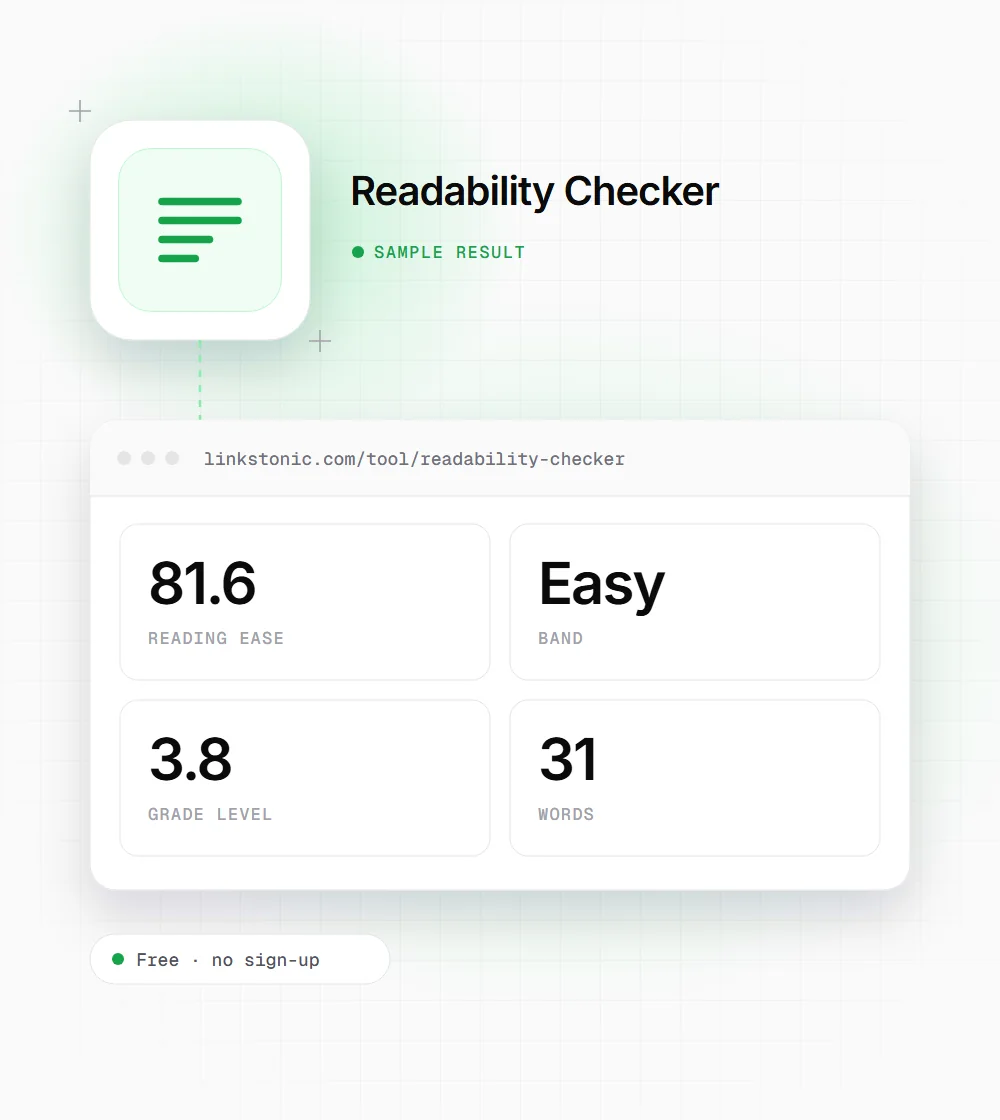
The migration was planned in March. Every old URL was mapped to a new one, and the redirects were tested before launch. Traffic dipped for two weeks. Then it came back.
The three hints are "was planned", "was mapped" and "were tested", all real passives. The syllable rule reads "planned" and "dipped" as two syllables each, so the true score is a little easier than 81.6.
Who checks readability
The score answers a different question for each of these readers.
Content editors
Run each section of a long guide separately before it goes to layout. The one section scoring 20 points below the rest is usually where a writer lost the thread, and it's quicker to fix now than after publishing.
Health, legal and finance writers
Patient leaflets and consumer finance pages often have plain-language targets set by an organization or a regulator. The grade level gives a fast first read on a draft before it goes to formal review.
Non-native English writers
Long sentences are the most common problem when writing in a second language. The grade level shows when a paragraph has drifted, and the passive hints point at sentences that could be more direct.
What the reading ease bands mean
The band label follows Flesch's original scale. The school levels are the rough reader equivalents usually quoted with it.
| Score | Band shown | Rough reading level |
|---|---|---|
| 90 to 100 | Very easy | 5th grade |
| 80 to 89.9 | Easy | 6th grade |
| 70 to 79.9 | Fairly easy | 7th grade |
| 60 to 69.9 | Standard | 8th and 9th grade |
| 50 to 59.9 | Fairly difficult | 10th to 12th grade |
| 30 to 49.9 | Difficult | College |
| 0 to 29.9 | Very difficult | College graduate |
Most general web copy lands between 60 and 70. Technical documentation often scores in the 30s and 40s and is still perfectly usable for its audience.
A score is a smoke alarm, not an editor
Flesch was built in the 1940s to grade printed prose. It knows nothing about meaning, only sentence length and syllables. A page of short, empty sentences scores beautifully. A precise explanation of HTTP caching scores badly. So I read the score as a prompt to look at the text again, never as a pass mark.
Google has never said it uses readability formulas to rank pages, and I wouldn't rewrite a page just to move a number. What the score catches well is the 45-word sentence that crept in during editing, and the paragraph where every other word has four syllables. Fixing those helps human readers, which is the point.
Plain sentences also quote well. AI Overviews, ChatGPT and Perplexity tend to lift a sentence or two that answers the question on its own. A sentence stuffed with three clauses is harder to lift cleanly than two short ones. If an answer paragraph scores below 50, try splitting its longest sentence first.
Moving the score without dumbing it down
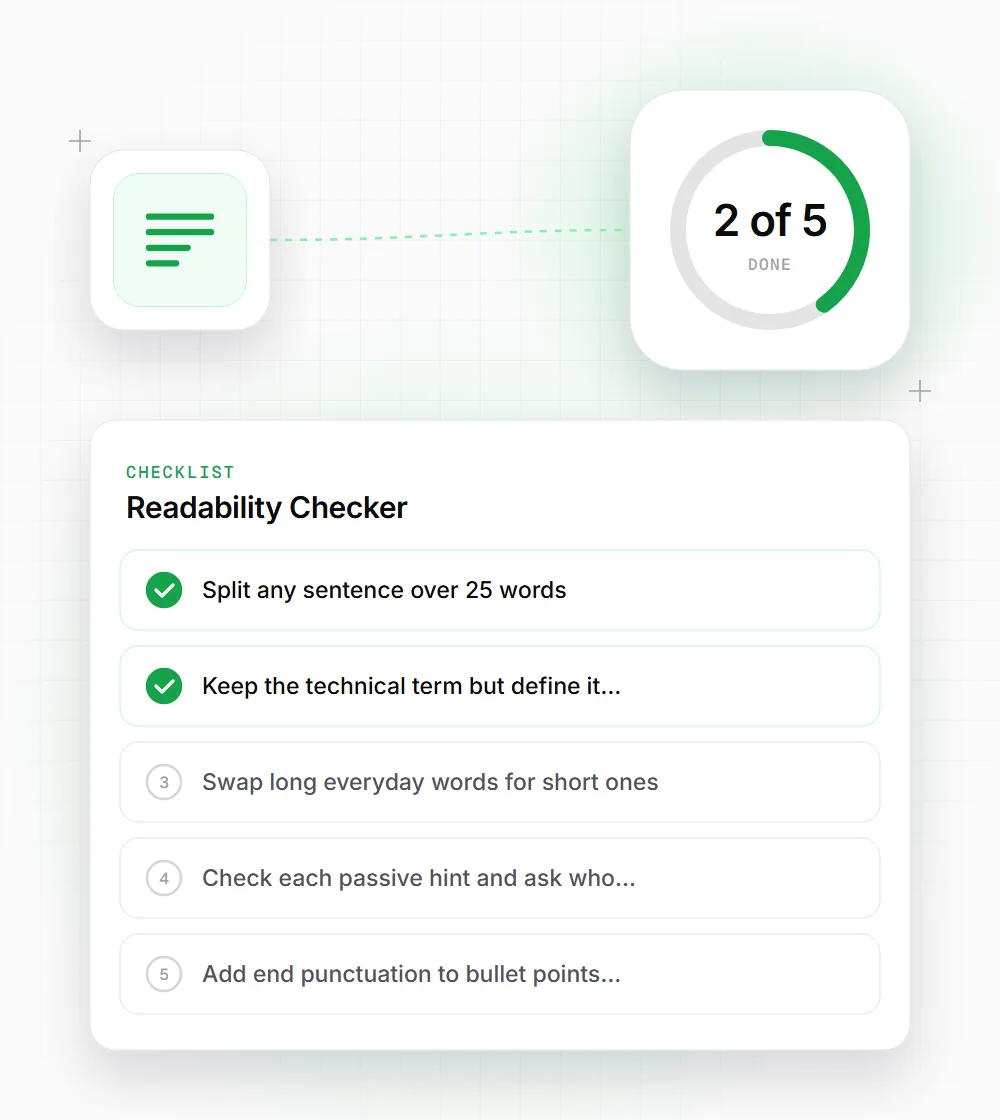
Long sentences move both formulas the most, so start there.
- 01
Split any sentence over 25 words. Look for "and", "which" or a semicolon and put a period there instead.
- 02
Keep the technical term but define it once in plain words the first time it appears.
- 03
Swap long everyday words for short ones: "use" for "utilize", "help" for "facilitate", "about" for "approximately".
- 04
Check each passive hint and ask who did the action. "We tested the redirects" is usually clearer.
- 05
Add end punctuation to bullet points that are full sentences, or the checker will read the whole list as one sentence.
- 06
Run each section separately. A single score for a 3,000-word article hides the one dense section that needs work.