Written to be quoted
Content Lab checks whether an answer engine can lift a clean, self-contained passage from your page. It flags the sections where the engine would give up and cite someone else.
Paste a URL, upload a draft or connect WordPress. Content Lab scores the page 0–100 for AI answer engines, points at what is holding it back and tells you what to change.
Sample analysis for illustration
Analyze content wherever it lives
 WordPress
 Search Console
Most SEO checks look at meta tags and keywords. They can't tell you whether an AI can pull a clean, confident answer out of your page. Content Lab checks exactly that.
Content Lab checks whether an answer engine can lift a clean, self-contained passage from your page. It flags the sections where the engine would give up and cite someone else.
Live URLs, PDF and Word drafts, or posts pulled from WordPress. The source changes, the 0–100 Content Score and gap list stay the same.
Re-run the analysis after each revision and watch the Content Score move. Editors can point to the number instead of arguing that a rewrite helped.
Keyword density isn't part of it. Content Lab looks at extractable passages, entity coverage, semantic structure and direct answers near the top, and every point on the score maps to something you can change.
Answer engines quote passages, so structure matters. Clear headings and a direct answer near the top make your content easy to lift.
A definition or answer within the first 100 words
A logical H2/H3 outline an AI parser can follow
Sections that mirror how people ask
Self-contained paragraphs that can be quoted alone
Key facts hidden where AI parsers won't surface them
Engines connect ideas through entities. Name the people, products and concepts that belong to the topic, with enough context that nobody could mistake them.
Relevant people, products and concepts named with context
How the named things relate to one another
Terms that usually appear alongside the topic
AI-suggested keywords and entities to add
Coverage across the wider topic cluster
Before an engine quotes you, it wants evidence: machine-readable structure, a named author and sources behind the claims.
Schema that marks up questions and answers
A named, identifiable author
Claims backed by reputable references
Supporting links that build topical authority
Statements precise enough to cite
With Search Console connected, Content Lab looks at the queries already bringing the page impressions and checks whether each one gets a clean answer.
Highest-impression queries with a direct answer
Queries touched on but never answered outright
Impression-bearing queries with no extractable answer
Gaps ranked by search volume impact
Content format that fits what searchers want
Connect Google Search Console and Content Lab shows the queries that already bring people to the page, and whether the content answers them well enough to get cited by AI.
See what the page already shows up for today, alongside what it could rank for.
High impressions plus no clean answer in the text means a citation gap. Content Lab labels it and tells you how to close it.
Connect through OAuth, the same flow SearchMind uses. After that, every analysis includes your query data.
Query coverage| Query | Impr. | Answer |
|---|---|---|
| best crm for small business | 14,200 | Covered |
| what does crm stand for | 9,800 | Gap |
| crm vs spreadsheet | 6,100 | Partial |
| free crm software comparison | 5,400 | Gap |
| how to choose a crm | 2,700 | Partial |
Audit live pages, review drafts before they ship or work inside WordPress. Pick whichever matches how your team already publishes.
Paste a live URL and get a full AI readiness report in seconds. Blog posts, landing pages, product pages: if it's publicly crawlable, it works. That includes competitor URLs.
Upload a PDF or Word doc before it goes live. Score draft whitepapers, long guides or client deliverables and see the gaps before anyone hits publish.
Drop a draft to score it
.pdf · .docxConnect your WordPress site and browse your posts inside Content Lab. Pick one, run the analysis, edit it and push the update back without leaving Linkstonic.
yourbrand.comConnectedWhat you get, from the first score to the push back to your CMS.
A 0–100 AI readiness rating based on extractability, entity density, structure and how directly the page answers.
The questions your page doesn't answer cleanly, ranked by search volume impact, so the big ones get fixed first.
Your actual Search Console impressions laid over the analysis, query by query.
Terms, relationships and co-occurring concepts the topic cluster expects and your page lacks.
Missing FAQ schema, weak header structure and buried content, plus where to restructure.
Flags pages with thin internal linking context. Pairs with LinkMind.
Publish, then wait and see if AI picks it up.
See the score and the gaps before it ships.
Paste a URL, drag in a PDF or browse your WordPress posts. If GSC is already connected through SearchMind, Content Lab uses that connection.
Entity coverage, structure, citation signals, semantic depth and GSC query coverage get checked in seconds. There is no 24-hour audit queue.
Each gap comes with a specific fix. Edit in place for WordPress or export a brief for your writer.
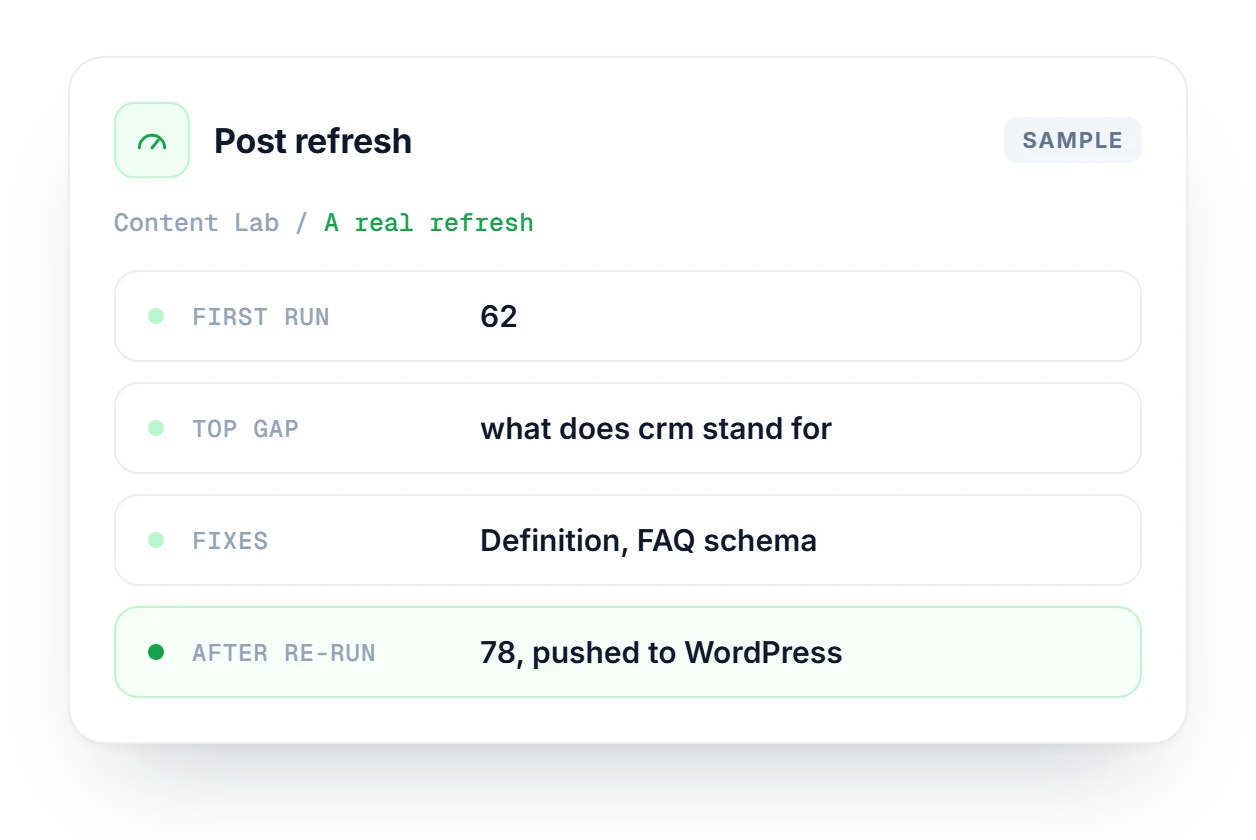
A year-old CRM roundup still gets impressions, but AI answers keep quoting a competitor. Content Lab, with Search Console connected, scores it 62 and flags "what does crm stand for" as the top citation gap. After adding a definition and FAQ schema, the re-run scores 78 and the update goes back to WordPress.
Go from topic to titles, outline and full draft, then send the draft to Content Lab in one click.
Explore AI WriterFix the weak internal linking Content Lab flags. LinkMind finds which pages should link to each one, and with what anchor.
Explore LinkMindFind the pages with the most impression potential in Search Console and run those through Content Lab first.
Explore SearchMindHow scoring works, which formats it takes and where it sits in your publishing process.
See which plan fits your team and how Content Lab ties into the rest of the platform.
Compare plans →It is a 0–100 rating of how ready a piece of content is to be cited by AI answer engines like ChatGPT, Perplexity and Gemini. It covers structural clarity, entity coverage, direct answers near the top and citation signals such as schema, author info and sourcing. With Search Console connected, it also checks how well the page answers queries that already bring it impressions.
Yes. Upload a PDF or .docx file and Content Lab scores it the same way it scores a live URL. That makes it useful for whitepapers, long guides and agency deliverables, because you catch citation gaps and structural problems before the document reaches a CMS.
No plugin needed. You connect your WordPress site through the standard REST API, and Content Lab lists your posts and pages. Pick one, run the analysis, edit it and push the updated content back to WordPress without leaving Linkstonic.
It shows what the page already appears for in search, and whether the content answers those queries well enough for an AI to cite it. Most content tools only guess at what a page could rank for. A query with thousands of impressions and no clean answer in the text gets labeled a citation gap, with a fix attached.
Yes. URL Analysis works on any publicly crawlable page, so you can score a competitor's article and benchmark it against your own. Comparing the two gap lists usually shows what their page does that yours doesn't.
Standard content tools focus on keywords, headings and meta tags. Content Lab checks whether an AI can read your whole page and pull out a clear, accurate answer to quote. It looks at passage extractability, entity relationships, answers near the top and semantic coherence. Keyword density and meta descriptions are only a starting point.
Start free, no credit card. Analyze a URL, upload a draft or connect WordPress and see where the citation gaps are.
 AI answer