UCP Readiness Report
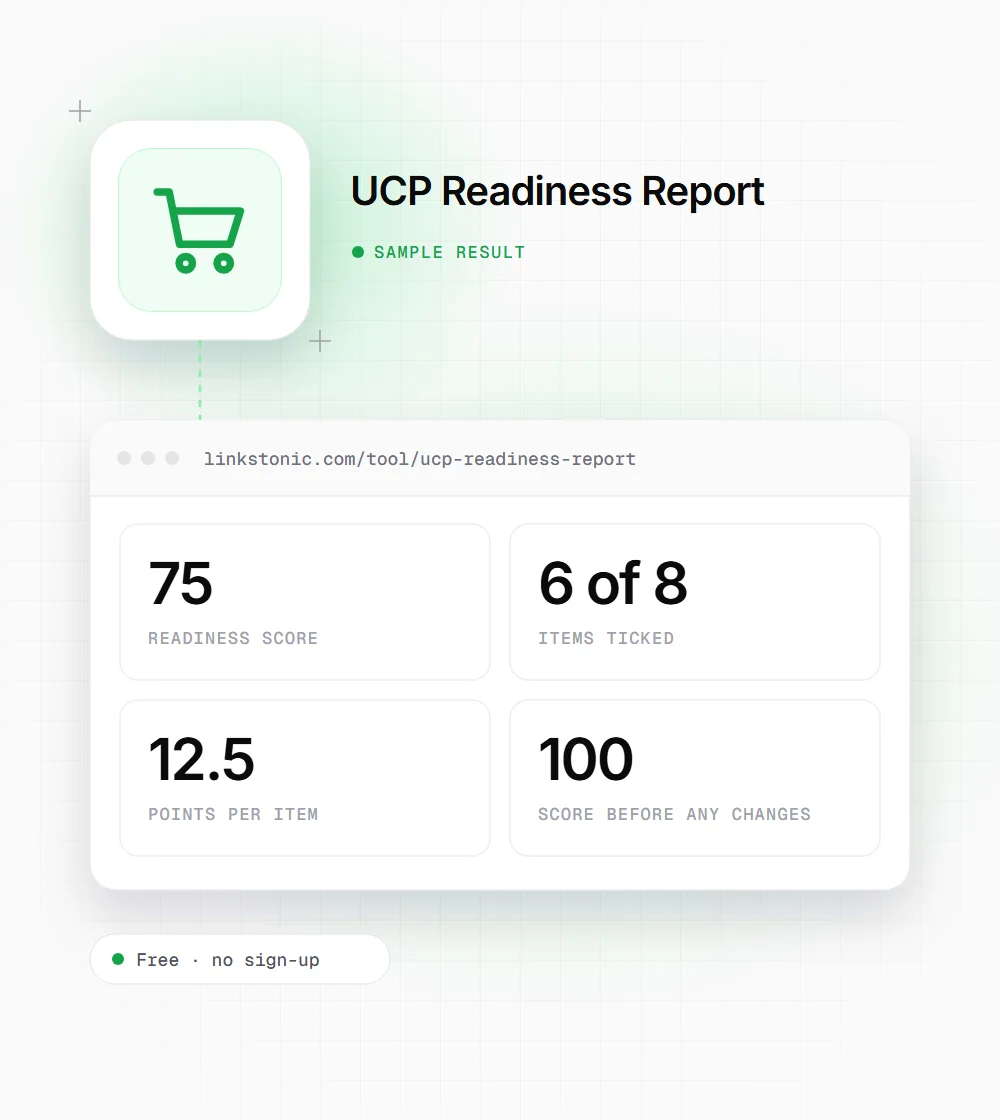
Work through eight checks that cover your product feed, checkout, payment methods, policies and merchant identity, and untick anything your store doesn't have yet. The score updates as you go, giving you a quick 0 to 100 read on how prepared you are for AI agents that shop on a customer's behalf.
Updated · by the Linkstonic team
How the score adds up
This is a self-assessment. It doesn't visit your store or read your feed, so the score is only as accurate as your answers.
Everything starts ticked
All eight items load checked, so the score opens at 100. The job is to untick whatever you can't confirm today. It's an easy tool to answer optimistically, so ask whoever runs your feed and checkout before you leave an item ticked.
Equal weights
Each item is worth 12.5 points and the total is rounded to a whole number. Seven items scores 88, six scores 75 and five scores 63. Payment methods count the same as error pages, even though one is likely to matter more for your store.
Data checks
Three items are about product data an agent reads: a structured feed with SKU, price and availability; inventory that syncs quickly enough that stock isn't stale; and locale and currency values that match what a shopper in that market actually pays.
Checkout checks
Three items are about the buying step: HTTPS checkout with carts that persist, payment methods declared in a way agents can read, and error pages that don't expose cart contents or other customer details when something fails mid-order.
Trust checks
The last two ask whether return and shipping policies are visible to crawlers, not hidden behind scripts or logins, and whether contact details and merchant identity sit on your own domain. Agents and the people approving their purchases both need to know who they're buying from.
Nothing is saved
Your answers live only in the open tab. Reload and every item is ticked again. If you're using the score to track progress, note which items you unticked, or take a screenshot, before closing the page.
A store with a slow feed and no agent payments
A Shopify-style store unticks two items: its inventory syncs once a day, and it hasn't declared payment methods for agents yet.
Unticked: "Inventory sync within acceptable staleness" and "Payment methods declared for agents". Other six left ticked.
Both gaps sit on the path to an actual purchase. An agent that can't pay, or that finds an item out of stock at checkout, fails the order even when every product detail is right.
Who fills in the checklist
Agent readiness cuts across teams, which is why a shared checklist helps.
E-commerce managers
Run it before a planning meeting to show which gaps belong to which team. Feed and inventory items go to merchandising, checkout and payment items to engineering, policy items to operations.
SEO and growth leads
Pair it with a Product schema check. Clean markup and feeds help a store show up in AI shopping answers, and this list covers the checkout side that decides whether an agent can finish the sale.
Agencies onboarding a store
Walk a new client through the eight items on the first call. The unticked ones make a short, concrete scope for the first month, and the score gives you a baseline to report against later.
Getting ready for agents that buy
UCP stands for Universal Commerce Protocol, an open standard Google introduced in early 2026 to let AI agents find products, build a cart and complete checkout with a merchant. It sits alongside OpenAI's Agentic Commerce Protocol, which covers checkout inside ChatGPT. Both are young, and the details are still changing.
That's why this tool is a checklist and not a scanner. The fundamentals it asks about hold whichever protocol wins: accurate feeds, a checkout that works without a human clicking through, clear policies and a merchant that's easy to verify. Stores that already sell well through Google Shopping have most of this in place.
The mistake I'd avoid is treating 100 as done. The score says you believe each item is true. It doesn't test anything. Read your platform's UCP documentation, run a test order through whichever agent integration your platform offers, and treat the score as a conversation starter with your commerce team.
Answering each item honestly
A few quick checks turn the checklist from a guess into something you can defend.
- 01
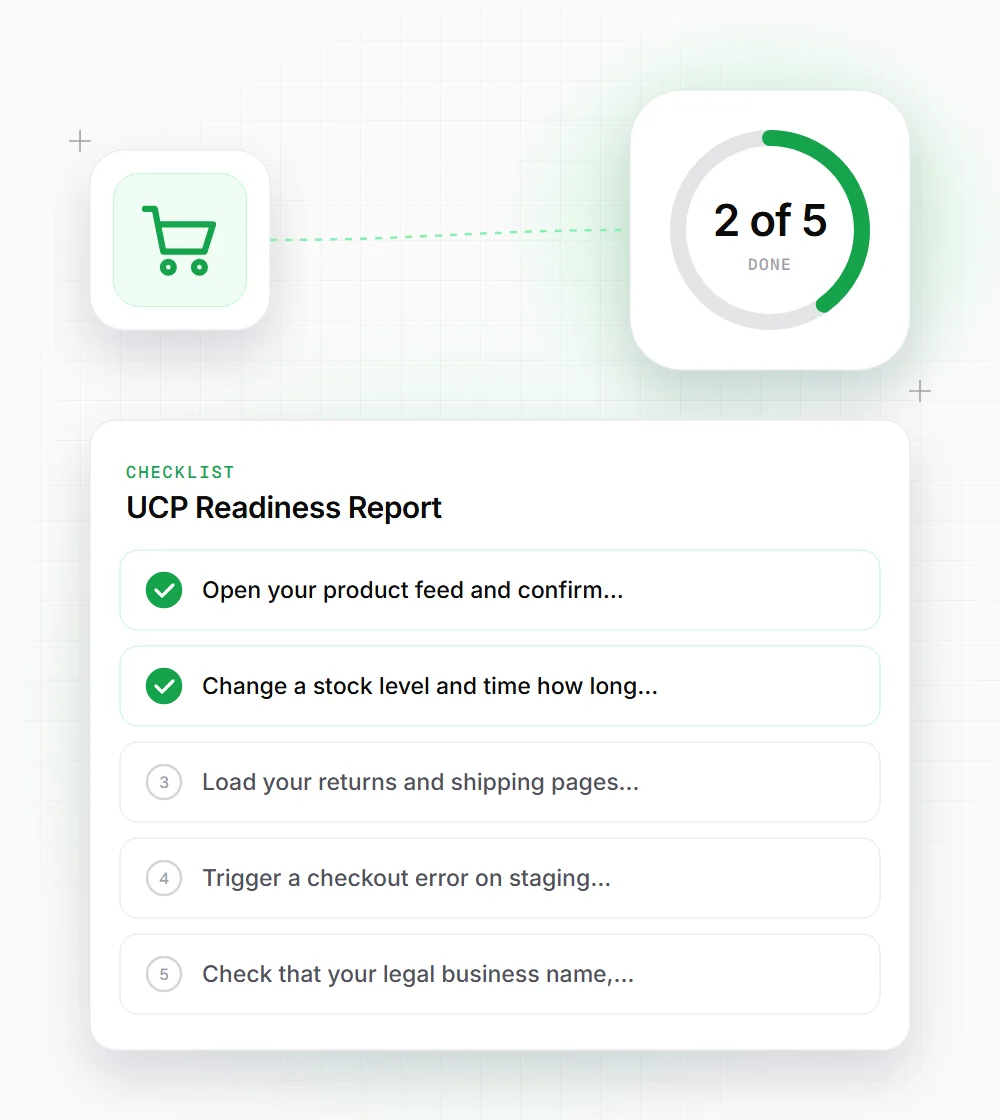
Open your product feed and confirm SKU, price and availability are filled for your ten best sellers.
- 02
Change a stock level and time how long the feed and the product page take to show it.
- 03
Load your returns and shipping pages with JavaScript turned off to see what a crawler gets.
- 04
Trigger a checkout error on staging and read the error page for cart or customer details.
- 05
Check that your legal business name, address and contact email appear on your own domain.