ACP Readiness Report
Go through eight things a store needs before AI agents can buy from it, from product data they can read to order updates they can follow, and untick what you don't have yet. The score updates instantly and shows the share of the list you already cover.
Updated · by the Linkstonic team
How the readiness score works
This is a checklist, not a crawler. You give the answers and the tool does the arithmetic, so the score is only as honest as your ticks.
The eight items
Merchant verification metadata, product JSON readable without login, an agent-readable offer summary, inventory hooks for reservations, structured refunds and cancellations, tax and duties hints, brand and storefront entity alignment, and a webhook or event feed for order state.
Starts at 100
Every box is ticked when the page loads, so the first number you see is 100. That is not a result. Work down the list and untick anything you can't point to in production today.
Equal weights
The score is ticked items divided by eight, times 100, rounded. Each item is worth 12.5 points, so seven ticks give 88, six give 75 and five give 63. A missing checkout webhook counts the same as missing tax hints.
Nothing is fetched
There's no URL box and no request to your store. The tool can't see your feed, your schema or your checkout. The panel labels the score as indicative only, and it's meant to be confirmed with whoever runs your commerce stack.
Nothing is saved
Ticks live in the page's memory. Reload or close the tab and the list resets to all ticked. Take a screenshot or copy the gaps into your ticket tracker before you leave.
A mid-size store's first pass
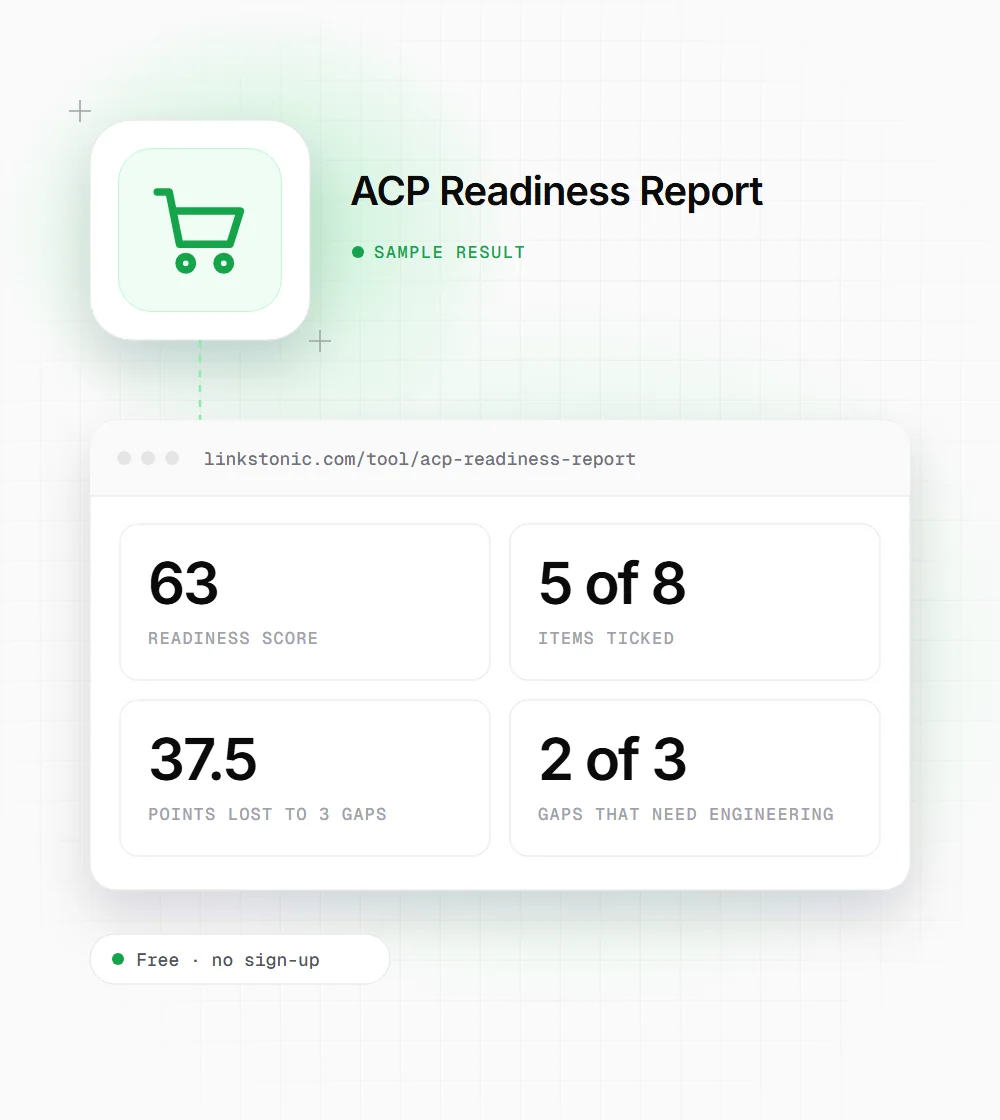
A store with a public product feed and schema, but no real-time integrations yet, would untick three items. This is the score the tool shows for that set of answers.
Ticked: merchant verification metadata, product JSON without auth, agent-readable offer summary, structured refunds / cancellations, brand-storefront entity alignment
Unticked: inventory hooks for reservations, tax and duties hints, webhook or event surface for order state
62.5 rounds up to 63. The two engineering gaps, reservations and order webhooks, are also the ones an agent needs to finish a purchase, so they matter more than the equal weights suggest.
Who uses the checklist
It works best when several teams fill it in together, because nobody owns all eight items.
Ecommerce SEO leads
A quick way to show leadership where the catalog data falls short for AI shopping, using language that doesn't need a protocol spec to understand. The unticked items become the first tickets.
Engineering managers
Three of the eight items, reservations, order webhooks and unauthenticated product JSON, are build work. The list helps size them before anyone commits to an agentic checkout launch date.
Agencies
Running the checklist live in a client call starts a practical conversation about feeds and policies, and the gaps it surfaces are concrete enough to scope.
What each checklist item means in practice
The labels in the tool are short. This is how we read them when we audit a store.
| Item | In practice | Usually owned by |
|---|---|---|
| Merchant verification metadata | Legal name, address and support contacts that match your payment and platform accounts | Operations |
| Product JSON without auth | A feed or Product schema an agent can read without logging in | SEO and engineering |
| Agent-readable offer summary | Price, currency, availability and shipping in structured fields, not only in images | SEO |
| Inventory hooks for reservations | An API that can hold stock while an agent completes checkout | Engineering |
| Structured refunds / cancellations | Return windows and cancellation rules as data, not a PDF | Customer service and SEO |
| Tax and duties hints | Whether prices include tax, and duties for cross-border orders | Finance |
| Brand and storefront alignment | The same brand name, logo and URLs across site, feed and schema | Marketing |
| Order state webhooks | Events for confirmed, shipped, refunded, so the agent can update the buyer | Engineering |
The checklist is our reading of agentic commerce needs, not the official protocol spec. Check the current ACP documentation before you build.
Why agentic checkout is a feed problem first
The Agentic Commerce Protocol, published by OpenAI and Stripe, is how an AI agent like ChatGPT can complete a purchase with a merchant on a shopper's behalf. The shopper never visits your product page. So everything a product page usually does, like showing price, stock and return terms, has to exist as clean data the agent can read.
That is why most stores we look at fail on the boring items, not the clever ones. Prices in images, return policies in PDFs, availability that only updates overnight. Fix those and you've also improved your Google Merchant Center feed and your Product rich results.
I'd be careful about treating the score as a grade. A store at 88 that lacks order webhooks can't finish an agent checkout at all, while a store at 75 missing tax hints mostly can. Read the unticked items, not the number.